
Apply The Knowledge Of Candlestick Patterns To Make Informed Trading Decisions In The Indian Stock Market
Candlestick Patterns: A Guide for Indian Stock Traders
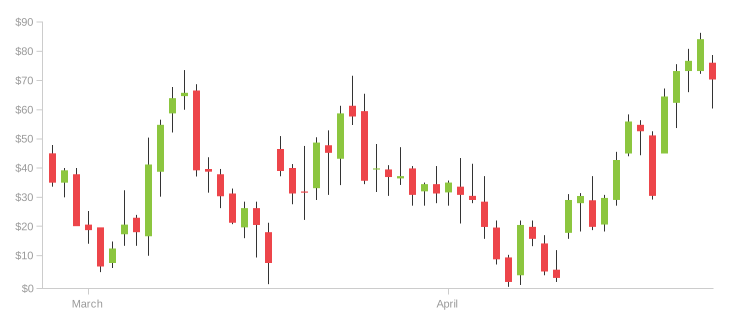
Candlestick patterns help traders in the Indian stock market read price movements and make smarter trading decisions. This charting method was first used in the 18th century by a Japanese rice trader named Munehisa Homma. Steve Nison later introduced it to Western traders. Today, candlestick charts are a key tool for understanding market sentiment and spotting possible price changes in stocks on the NSE and BSE.
The Anatomy of a Candlestick

🔥 The Body
The body of a candlestick shows the open and close prices. A filled or colored body means the close was lower than the open (bearish). A hollow or uncolored body means the close was higher than the open (bullish).
🔥 The Wicks
Wicks, also called shadows, are the thin lines above and below the body. They show the highest and lowest prices during that time period.
Single Candlestick Patterns

🔥 The Doji
A Doji forms when the open and close prices are nearly the same. This tells you the market is undecided.
Example: A Doji in the Nifty 50 index could signal a possible reversal after a strong uptrend.
🔥 The Hammer and Hanging Man
Both have small bodies and long lower wicks. A Hammer appears after a price drop and can signal a bullish reversal. A Hanging Man appears after a price rise and can warn of a bearish reversal.
Example: A Hammer pattern in Reliance Industries might point to a possible bullish reversal.
🔥 The Inverted Hammer and Shooting Star
These are the opposite of the Hammer and Hanging Man. They have long upper wicks. The Inverted Hammer suggests a bullish reversal. The Shooting Star points to a bearish reversal.
Example: A Shooting Star in Infosys after a period of gains could warn of a potential price drop.
Multiple Candlestick Patterns

🔥 The Bullish and Bearish Engulfing
These patterns use two candlesticks. The body of the second candle fully covers the body of the first. Bullish Engulfing suggests buyers are taking control. Bearish Engulfing suggests sellers are taking over.
Example: A Bullish Engulfing pattern in HDFC Bank may be a buy signal for traders.
🔥 The Morning Star and Evening Star
A three-candle pattern with a small-bodied candle between two long-bodied candles of opposite colors. The Morning Star is bullish. The Evening Star is bearish.
Example: An Evening Star formation in Tata Motors could be a sign for investors to consider exiting long positions.
🔥 The Three White Soldiers and Three Black Crows

These are three long-bodied candlesticks moving in the same direction. Three White Soldiers show rising bullish momentum. Three Black Crows show growing bearish momentum.
Example: Three White Soldiers in the SENSEX chart could support a bullish outlook.
How to Use Candlestick Patterns in Your Trading

🔥 Confirmation Is Key
Always look for extra signals or patterns to confirm what a candlestick pattern is telling you before you trade.
🔥 Volume Matters
When a candlestick pattern forms with high trading volume, it is usually more reliable.
🔥 Context Is Crucial
Look at the overall trend and market conditions. Never use candlestick patterns on their own.
🔥 Practice Makes Perfect
Use historical charts to practice recognizing candlestick patterns and learn how they play out.
Real Examples: Candlestick Patterns in Indian Stocks
🔥 The Bullish Turnaround
In 2020, a Bullish Engulfing pattern appeared on the chart of TCS. A strong uptrend followed, rewarding traders who spotted the pattern early.
🔥 The Warning Sign
In 2018, an Evening Star pattern in Yes Bank’s chart warned of a steep decline. This shows why it pays to pay attention to bearish signals.
Making Candlestick Patterns Work for You
Candlestick patterns work best when you combine them with other tools like volume and trend analysis. No single pattern is a sure thing. But learning to read these patterns can help you make more informed trading decisions in the Indian stock market. Use them as one part of your strategy, not the whole plan.
Quick learning plan:
Learn the basics: Start with candlestick parts like the body, wick, and color. Study common patterns such as the bullish engulfing and hanging man.
Spot key patterns: Learn to identify doji, hammer, shooting star, and other patterns. Look for them in Indian stocks like Nifty 50 and SENSEX.
Understand what patterns mean: Learn to tell the difference between reversal patterns and continuation patterns. See how each affects price movement.
Apply patterns to real trades: Use your knowledge of candlestick patterns to make smarter trading choices in the Indian stock market.
Practice on charts: The more charts you study, the better you become at spotting patterns and making informed trading decisions.

Free Registration for Stock Market Tips ( Advisory Services)
As per the SEBI rules, we will provide our Services only to those clients who have Complete Risk Profile. Fill This Registration Form and
Contact us on
- Whatsapp @ +91 95999 69624
- Call Us @ +91 9650 890 321
for further process.
Risk Profiling is COMPULSORY
Everything You Need to Know About Candlestick Patterns in the Indian Stock Market
Candlestick patterns are visual representations of price movements used by traders in the Indian stock market to identify potential trend reversals, continuations, and market sentiment on indices such as the Nifty 50 and SENSEX, as well as individual stocks listed on the NSE and BSE. Each candlestick displays the open, high, low, and close price for a specific time period, and patterns formed by multiple candlesticks help traders interpret market psychology and make informed trading decisions.
What are candlestick patterns and how do they work in the Indian stock market?
Candlestick patterns are formations created by one or more candlesticks on a price chart. In the Indian stock market, traders use these patterns to identify potential entry and exit points. Each pattern reflects the battle between buyers and sellers during a given period. Patterns are broadly classified as reversal patterns, which signal a possible change in trend direction, or continuation patterns, which suggest the existing trend will persist.
What are the most reliable candlestick patterns for NSE and BSE stocks?
Some of the most widely tracked patterns on NSE and BSE charts include the Bullish Engulfing pattern, Bearish Engulfing pattern, Doji, Hammer, Shooting Star, Morning Star, Evening Star, Three White Soldiers, and Three Black Crows. The Bullish Engulfing pattern is considered particularly reliable when accompanied by high trading volume, as it signals a strong shift from selling to buying pressure.
How do Indian stock traders use candlestick patterns to predict price movements?
Traders on the NSE and BSE combine candlestick patterns with technical indicators such as volume analysis, support and resistance levels, and trendlines to increase the probability of successful trades. A candlestick pattern alone is not a sufficient signal. Traders wait for confirmation in the following candle or through rising volume before acting on a pattern. Patterns observed on daily and weekly charts tend to carry more weight than those seen on shorter timeframes.
Do candlestick patterns work differently in the Indian stock market compared to global markets?
Candlestick patterns work the same way regardless of the market because they are based on universal principles of supply and demand. However, Indian stock market traders note that patterns may be more reliable on highly liquid stocks in the Nifty 50 and SENSEX due to consistent trading volume. On lower-volume stocks, pattern signals may be less dependable and require additional confirmation.
How can beginners learn to identify candlestick patterns on Indian stock charts?
Beginners can start by studying historical charts of well-known Indian stocks such as Reliance Industries, TCS, HDFC Bank, and Infosys. Practicing on daily and weekly timeframes helps learners recognize common patterns like the Doji and Hammer more quickly. Many trading platforms and educational resources offer charting tools that allow users to scan for specific candlestick patterns across NSE and BSE stocks.
- What is a candlestick pattern in stock trading?
- A candlestick pattern is a formation created by the arrangement of one or more candlesticks on a price chart, used by traders to interpret market sentiment and anticipate potential price movements.
- Which candlestick pattern is most reliable for Indian stocks?
- The Bullish Engulfing and Bearish Engulfing patterns are among the most reliable for Indian stocks, especially when they appear at key support or resistance levels and are accompanied by above-average trading volume.
- How do you identify a bullish reversal pattern?
- A bullish reversal pattern, such as the Hammer or Morning Star, typically appears after a downtrend and signals that buying pressure may be overcoming selling pressure, potentially leading to an upward price move.
- What does a Doji candle mean in the Indian stock market?
- A Doji candle indicates indecision in the market, where the open and close prices are nearly equal. In the Indian stock market, a Doji after a strong trend may warn of a possible reversal or a period of consolidation.
- Can candlestick patterns be used alone for trading decisions?
- Candlestick patterns should not be used alone for trading decisions. They are most effective when combined with other forms of analysis such as volume, trendlines, and support and resistance levels.
- Where can I practice reading candlestick patterns on Indian stock charts?
- Traders can practice reading candlestick patterns using free charting tools available on NSE and BSE websites, brokerage platforms, and educational resources that provide historical stock data for analysis.