
The Price-To-Earnings (P/E) Ratio And Its Significance In Stock
The price-to-earnings (P/E) ratio and its significance in stock analysis

The P/E ratio is one of the most widely used metrics for evaluating the relative value of a stock? It provides insight into how much investors are willing to pay for each dollar of a company’s earnings.
# Example:
# Company A has a stock price of $100 and earnings per share (EPS) of $5.
# Its P/E ratio would be 20 ($100 / $5).
P/E Ratio Calculation
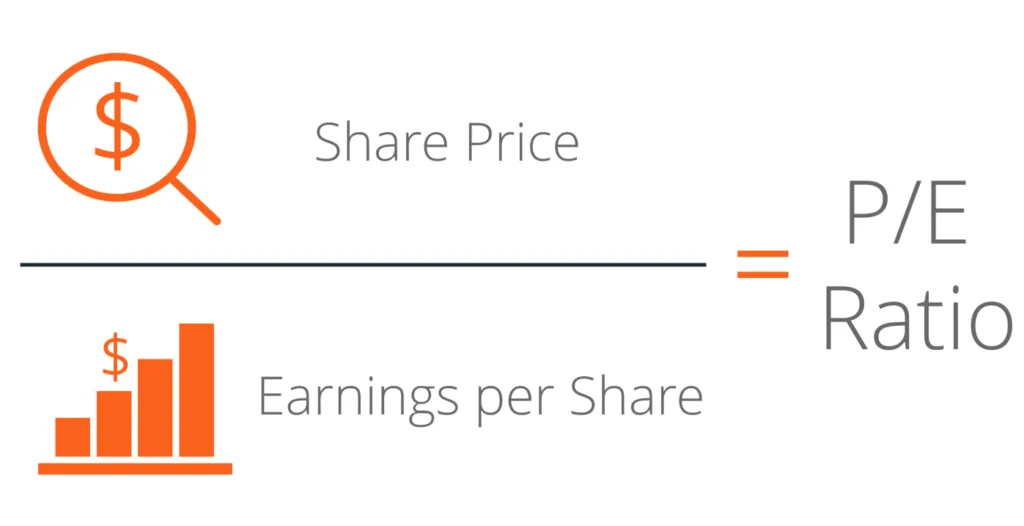
The P/E ratio is calculated by dividing the current market price of a stock by its earnings per share (EPS). The EPS is usually based on the company’s trailing twelve months (TTM) or estimated future earnings. This ratio indicates how much an investor is willing to pay for each dollar of earnings. A high P/E ratio may suggest that investors are expecting higher future growth, while a low P/E ratio may indicate undervaluation or lower growth expectations.
# Example:
# Company B has a stock price of $50 and TTM EPS of $2.50.
# Its P/E ratio would be 20 ($50 / $2.50).
Significance in Stock Analysis

The P/E ratio is a key tool for comparing the valuation of different stocks within the same industry or across industries. It helps investors assess whether a stock is overvalued, undervalued, or fairly priced relative to its earnings potential. However, it’s important to consider other factors such as growth prospects, industry trends, and market conditions when interpreting the P/E ratio.
# Example:
# Company C operates in the same industry as Company A and has a P/E ratio of 15.
# This suggests that investors are willing to pay less for each dollar of Company C's earnings compared to Company A.
Limitations and Considerations
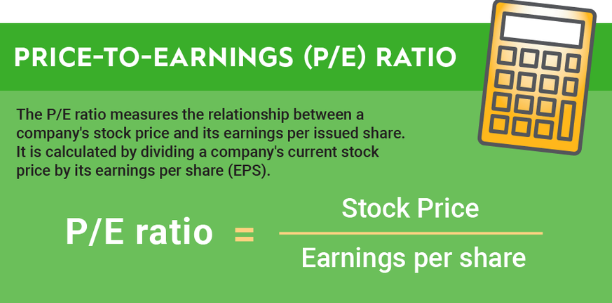
While the P/E ratio provides valuable insights, it has limitations. For instance, it may not account for extraordinary items, one-time expenses, or non-recurring events that impact earnings. Additionally, comparing P/E ratios across industries with different growth rates or capital structures may not provide an accurate assessment of relative value. Investors should use the P/E ratio in conjunction with other financial metrics for comprehensive analysis.
# Example:
# Company D has a P/E ratio of 25, but it recently incurred a significant one-time expense, impacting its earnings.
# In this case, the P/E ratio may not accurately reflect the company's true valuation.
Forward P/E Ratio and Growth Considerations

Investors often use the forward P/E ratio, which uses estimated future earnings, to account for expected changes in a company’s profitability. When evaluating high-growth companies, it’s essential to consider the PEG (P/E to growth) ratio, which factors in the company’s growth rate. A low PEG ratio relative to similar companies may indicate a potentially undervalued stock with strong growth prospects.
# Example:
# Company E is expected to have significant earnings growth in the next year, resulting in a forward P/E ratio of 15.
# Considering its high growth potential, the PEG ratio of 0.8 suggests that the stock may be undervalued.
The P/E ratio and its significance in stock analysis is essential for investors seeking to make informed investment decisions. By considering the P/E ratio in conjunction with other financial metrics, industry dynamics, and growth prospects, investors can gain valuable insights into the relative valuation of stocks and identify potential investment opportunities.
# Example:
# By analyzing the P/E ratios of multiple companies in the same sector, investors can identify stocks that may be undervalued or overvalued relative to their earnings potential.
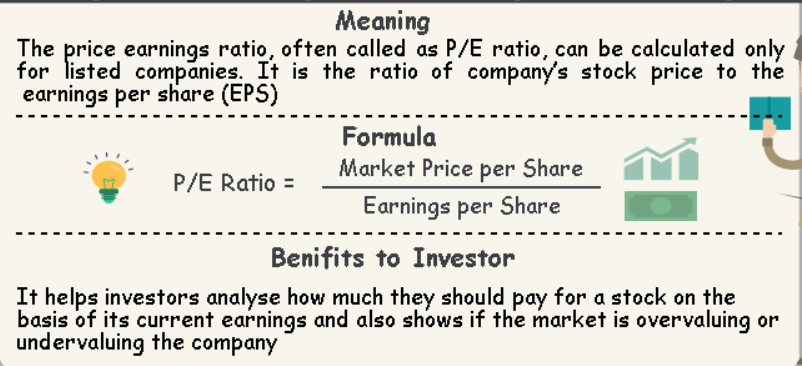
To do: Calculate the price-to-earnings (P/E) ratio for a specific stock to analyze its significance in stock analysis.
Short step-by-step plan:
Gather the required information:
- Go to a financial website like Yahoo Finance and find the current stock price and the earnings per share (EPS) for the company you want to analyze.
- For example, if you are interested in analyzing Apple Inc. (AAPL), you can find the stock price and EPS on Yahoo Finance.
Calculate the P/E ratio:
- Divide the current stock price by the EPS to calculate the P/E ratio.
- For example, if the current stock price of AAPL is $150 and the EPS is $5, then the P/E ratio would be 150/5 = 30.
Interpret the P/E ratio:
- Understand the significance of the calculated P/E ratio in stock analysis. A higher P/E ratio indicates that investors are willing to pay more for each dollar of earnings, suggesting that the stock may be overvalued. Conversely, a lower P/E ratio may signal that the stock is undervalued.
- For the example of AAPL, a P/E ratio of 30 suggests that investors are willing to pay 30 times the company’s earnings, indicating a relatively high valuation.
Compare with industry average and historical P/E:
- Compare the calculated P/E ratio with the industry average and the company’s historical P/E ratio to gain further insights into the stock’s valuation.
- For AAPL, compare the P/E ratio of 30 with the industry average and previous P/E ratios to assess its relative valuation.
Make informed investment decisions:
- Utilize the P/E ratio along with other fundamental and technical analysis to make well-informed investment decisions.
- Based on the calculated P/E ratio and additional analysis, decide whether to buy, hold, or sell the stock.

Free Registration for Stock Market Tips ( Advisory Services)
As per the SEBI rules, we will provide our Services only to those clients who have Complete Risk Profile. Fill This Registration Form and
Contact us on
- Whatsapp @ +91 95999 69624
- Call Us @ +91 82 7799 7560
for further process.
Risk Profiling is COMPULSORY
Stock Market Analysis and Predictions for 2025 Current Market Conditions The stock market is very volatile right now, causing worry among …
Popcorn Tax: Effects the Indian Economy The government of India has recently made the decision to increase the Goods and Services Tax …
Summary of India’s GDP Data Key Data Release An important GDP data release was scheduled post-market closure on November 29. This data …
Nifty Stock Market Analysis by EquityX 25-11-2024 Final Closing Details Nifty Closing Level: 23970 Friday’s Closing Gain: Nifty surged by 557 points. …
The Impact of Liquidity on Intraday Trading Strategies for Maximizing Returns Intraday trading, also known as day trading, involves buying and selling …
Mastering Intraday Equity Trading Top 10 Intraday Trading Tips for Success Intraday equity trading can be an exciting and profitable venture, but …
Strategies for Successful Intraday Equity Trading Intraday trading in the fast-paced world of equity markets can be both thrilling and challenging. With …
The Art of Using Stop-Loss Orders in Intraday Equity Trading Intraday equity trading can be a thrilling and potentially lucrative venture for …
Important Tools for Analyzing Intraday Equity Markets Intraday trading in equity markets can be thrilling and profitable, but it also requires a …
Share Market Tips For Beginners The share market, also known as the stock market, is a crucial component of the global financial …
What Are Macroeconomic And Market-Specific Risks Macro and Market Risks Macroeconomic and market-specific risks can significantly impact the financial performance of businesses …
What Are Risk Management Strategies In Stock Portfolio Risk Management Strategies: In the context of stock portfolio management, risk management refers to the process …
What Are Financial And Business Risks In Stock Investments Interesting Fact: financial and business risks are inherent in stock investments, and understanding …
Risk Assessment Not All Risks Are Equal? When it comes to investing in the Indian stock market, understanding and assessing risk is …
What Are Regulatory And Geopolitical Factors Influencing Stock Investments Regulatory Factors in Stock Investments Regulatory factors play a crucial role in influencing …
What Are Industry Trends And Competitive Positioning Of Companies Industry Trends and Competitive Positioning Analyzing industry trends and competitive positioning is crucial …
Assessing Management Quality And Corporate Governance Practices Interesting Fact: The quality of management and corporate governance practices can significantly impact a company’s …
Qualitative Analysis Companies Have Personalities? Just like people, every company has its own personality, which can be understood through Qualitative Analysis. This type …
What Is Price-To-Book (P/B) Ratio And How It Can Help In Evaluating Stock The Price-to-Book (P/B) Ratio The P/B ratio is a …
Discounted Cash Flow (DCF) Analysis And Its Application In Stock Valuation Discounted Cash Flow (DCF) Analysis Discounted Cash Flow (DCF) analysis is …
Valuation Techniques True Worth of a Company? Valuing a company is both an art and a science. Investors around the world use …
What are Undervalued And Overvalued Stocks Based On Fundamental Analysis Fundamental Analysis fundamental analysis is a method used to evaluate the intrinsic …
What are Economic Indicators And Their Impact On Stock Prices The stock market is influenced by a wide range of economic indicators? …
Financial Statement Analysis: Balance Sheet, Income Statement, And Cash Flow The balance sheet, income statement, and cash flow statement are the three …
Technical Analysis Indicators To Make Informed Investment Decisions Technical Analysis Indicators Technical analysis indicators are mathematical calculations based on historical price, volume, …
Technical Analysis Tools For Short-Term Stock Market Investment 📈 Candlestick Patterns Candlestick patterns are a crucial part of technical analysis. These patterns provide …
Technical Analysis For Short Term Trading Charts Can Tell Stories? Investing in the stock market is not just about picking stocks at …
What Are The Impact Of Market Trends On Stock Selection Market Trends and Their Impact on Stock Selection Market trends can significantly …
Criteria For Selecting Stocks For Short-Term Investments The Stock Selection Criteria Did you know that stock selection criteria play a crucial role …