How Industry Trends Affect a Company’s Growth Potential
Industry trends can significantly influence a company’s revenue growth, profitability, competitive strength, and long-term business prospects. Even a well-managed company may struggle if it operates in an industry facing declining demand, heavy regulation, technological disruption, or intense pricing pressure.
Investors should therefore evaluate both the company and the broader industry in which it operates. Important industry trends include changes in consumer behaviour, technological developments, government policies, raw material costs, interest rates, competition, and overall economic conditions.
For example, rising demand for renewable energy may create growth opportunities for companies involved in solar power, wind energy, battery storage, and related infrastructure. At the same time, companies that fail to adapt to this shift may gradually lose market relevance.
Some important factors investors should examine include:
- Current and expected industry growth rate
- Changes in customer demand
- Technological innovation and disruption
- Government regulations and policy support
- Availability and cost of raw materials
- Entry of new competitors
- Changes in pricing and profit margins
- Exposure to economic cycles
A growing industry can offer strong opportunities, but investors should still determine whether the company is capable of converting industry growth into sustainable earnings.
Key Indicators of a Strong Competitive Position
Competitive positioning refers to a company’s ability to perform better than its competitors and maintain its market position over time. A company with strong competitive positioning may be able to increase market share, protect profit margins, retain customers, and respond effectively to changing industry conditions.
Investors can evaluate competitive strength through several financial and non-financial indicators.
Market Share
A company gaining market share may indicate stronger products, better distribution, effective pricing, or superior customer acceptance. However, investors should also check whether market share growth is being achieved profitably rather than through excessive discounts.
Pricing Power
Pricing power is the ability of a company to increase prices without losing a significant number of customers. Companies with trusted brands, differentiated products, or limited competition often have stronger pricing power.
Profit Margins
Consistently higher operating or net profit margins compared with industry peers may indicate better cost control, stronger pricing, operational efficiency, or a competitive advantage.
Customer Loyalty
High customer retention and repeat purchases can provide stable revenue and reduce marketing costs. Customer loyalty is especially important in consumer goods, financial services, technology, and subscription-based businesses.
Distribution Strength
A wide and efficient distribution network can make it difficult for new competitors to enter the market. Distribution strength may include physical outlets, dealers, digital platforms, logistics capabilities, or long-term channel relationships.
Innovation Capability
Companies that consistently invest in research, product development, technology, and process improvement may be better prepared for changing customer needs and industry disruption.
Financial Strength
A strong balance sheet, manageable debt, healthy cash flow, and adequate liquidity can help a company survive industry downturns and invest in future growth.
Competitive Advantage and Economic Moats
A competitive advantage becomes more valuable when it is difficult for competitors to copy. A long-lasting competitive advantage is often described as an economic moat.
An economic moat can help a company protect its market share, profitability, and long-term returns despite competition.
Brand Strength
A trusted brand can influence customer preference and allow a company to charge premium prices. Strong brands may also reduce the cost of acquiring new customers.
Cost Advantage
A company may produce goods or deliver services at a lower cost than competitors because of scale, efficient operations, better sourcing, technology, or location advantages.
Network Effects
A network effect occurs when a product or platform becomes more valuable as more people use it. This is commonly seen in payment platforms, online marketplaces, social networks, and digital ecosystems.
Switching Costs
Customers may avoid changing providers when switching involves financial cost, operational disruption, data migration, retraining, or inconvenience. High switching costs can support customer retention.
Intellectual Property
Patents, proprietary technology, specialised knowledge, trademarks, and exclusive licences can protect a company from direct competition.
Regulatory Barriers
Licensing requirements, compliance costs, approvals, or strict regulations may make it difficult for new companies to enter certain industries.
Distribution Advantage
A company with a well-established distribution network may reach customers faster and more efficiently than its competitors.
Investors should examine whether the company’s competitive advantage is sustainable or likely to weaken because of changing technology, customer preferences, or new competition.
Industry Life Cycle and Its Impact on Companies
Industries generally pass through different stages of development. Understanding the industry life cycle can help investors assess growth opportunities and risks.
Emerging Stage
An emerging industry is usually characterised by new technology, low market penetration, uncertain demand, and high business risk. Companies may grow rapidly, but profitability can remain unpredictable.
Growth Stage
During the growth stage, customer demand increases, revenues expand, and successful companies may gain market share. Competition also increases as new businesses enter the industry.
Mature Stage
In a mature industry, growth generally slows and competition becomes more focused on pricing, efficiency, market share, and customer retention. Established companies may generate stable cash flows, but future growth may be limited.
Decline Stage
A declining industry may face falling demand, technological replacement, regulatory restrictions, or changing consumer behaviour. Companies operating in such industries may need to diversify, innovate, or reduce costs to remain competitive.
Investors should avoid assuming that every company in a growing industry will perform well. Similarly, a strong company in a mature industry may still generate stable earnings if it has pricing power, loyal customers, and efficient operations.
How Investors Can Compare Companies Within the Same Industry
Comparing companies within the same industry provides a more meaningful assessment than comparing businesses with completely different operating models. Investors should review financial performance, business quality, market position, and future risks together.
| Comparison Factor | What Investors Should Examine | Why It Matters |
|---|
| Industry Growth | Demand growth, market size, policy support, and future outlook | Indicates the overall opportunity available to companies |
| Market Share | Whether the company is gaining or losing share | Shows competitive strength and customer acceptance |
| Revenue Growth | Growth compared with industry peers | Helps identify companies outperforming the sector |
| Profit Margins | Gross, operating, and net profit margins | Reflects pricing power and cost efficiency |
| Return on Capital | ROCE and ROE compared with competitors | Shows how efficiently capital is being used |
| Debt Level | Debt-to-equity ratio and interest coverage | Indicates financial risk and balance-sheet strength |
| Cash Flow | Operating cash flow and free cash flow | Helps assess the quality of reported profits |
| Brand Strength | Customer trust, recognition, and loyalty | Supports pricing power and repeat demand |
| Innovation | Product development, technology, and R&D investment | Indicates ability to respond to disruption |
| Distribution Network | Market reach, dealers, digital access, and supply chain | Can create a strong barrier against competitors |
| Management Quality | Capital allocation, execution, and governance | Influences long-term business performance |
| Valuation | P/E, P/B, EV/EBITDA, and growth-adjusted valuation | Helps determine whether strengths are already priced in |
Investors should not depend on a single ratio or factor. A complete analysis should combine industry outlook, competitive positioning, financial performance, valuation, and risk.
Risks of Investing in Weak or Declining Industries
A company may appear financially attractive based on past results, but its future performance can weaken if the overall industry is under structural pressure.
Some common industry-level risks include:
- Declining customer demand
- Technological disruption
- Strong substitute products or services
- Rising regulatory costs
- Excess production capacity
- Intense price competition
- Increasing raw material costs
- Entry of stronger competitors
- Dependence on government incentives
- Changes in consumer preferences
Investors should distinguish between temporary industry weakness and long-term structural decline. Temporary weakness may result from economic cycles, while structural decline may permanently reduce the industry’s future growth potential.
Common Mistakes in Industry and Competitive Analysis
Investors may reach incorrect conclusions when they focus only on recent performance or use incomplete comparisons.
Common mistakes include:
- Assuming that a fast-growing industry guarantees strong investment returns
- Ignoring valuation while selecting an industry leader
- Comparing companies from different business segments
- Focusing only on revenue growth and ignoring profitability
- Overlooking debt and cash-flow quality
- Treating temporary market share gains as a permanent advantage
- Ignoring technological and regulatory risks
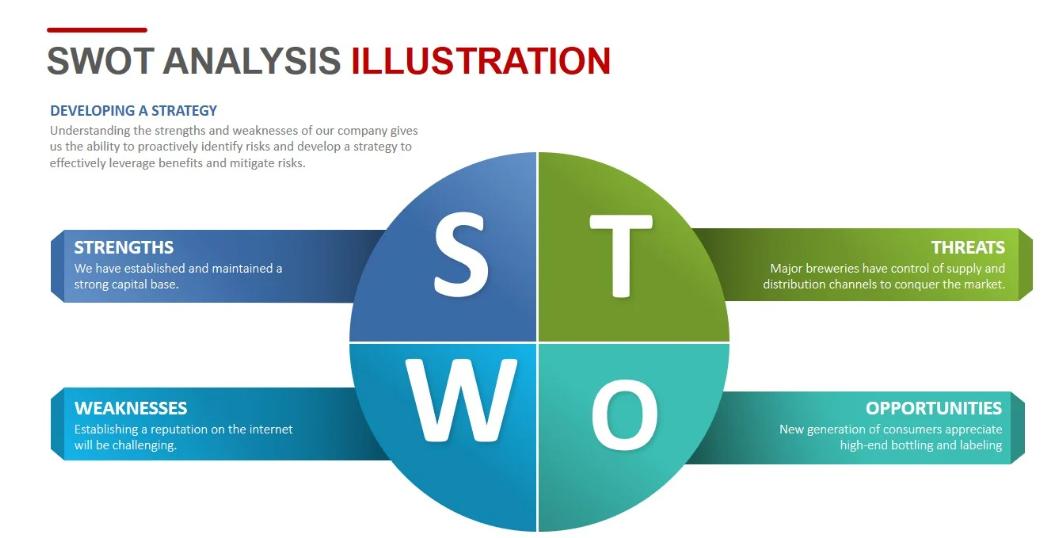
- Depending only on SWOT analysis without financial evaluation
- Using outdated industry data
- Assuming that a well-known brand always has a sustainable moat
A balanced analysis should consider both opportunities and risks before reaching an investment conclusion.
Using Industry and Competitive Analysis in Investment Decisions
Industry analysis helps investors understand the environment in which a company operates, while competitive analysis shows how effectively the company is positioned within that environment.
A company operating in a growing industry may benefit from increasing demand, but it must still demonstrate strong execution, financial discipline, and a sustainable competitive advantage. Similarly, a company in a mature industry may remain attractive if it has stable cash flows, high customer loyalty, pricing power, and efficient operations.
Investors should use industry trends and competitive positioning together with financial statement analysis, management evaluation, valuation, and risk assessment. No single framework can provide a complete investment decision on its own.
Related tools and guides
For live data and further reading, see how to value a stock, financial statement analysis and portfolio advisory services.