
Technical Analysis For Short Term Trading
How to Use Technical Analysis for Short-Term Trading

Looking for more than just short term equity tips? Technical analysis helps you study past stock prices and trading volume to find useful patterns. These patterns can give clues about where a stock price might go next. This guide covers the basics of technical analysis for short-term trading to help you trade with more confidence.
What is Technical Analysis?

Technical analysis is a way to study stocks by looking at past prices and trading volume. Instead of figuring out what a stock is really worth, analysts study charts and technical analysis tools to spot patterns. These patterns can suggest where the price might go next.
Chart Types for Short-Term Trading

Before diving into patterns and indicators, it’s crucial to understand the types of charts used in technical analysis:
Line Charts: The simplest form, representing the closing prices over a set period.
Bar Charts: Provide more data than line charts, showing the opening, high, low, and closing prices (OHLC) for each period.
Candlestick Charts: Similar to bar charts but offer a more visual representation of the price movement.
How to Spot a Trend

One of the foundational concepts in technical analysis is the trend. The trend is the general direction in which a stock price is moving. There are three types of trends:
Uptrend: Successive higher highs and higher lows.
Downtrend: Successive lower highs and lower lows.
Sideways/Horizontal Trend: Little movement up or down in the price.
Support and Resistance Levels
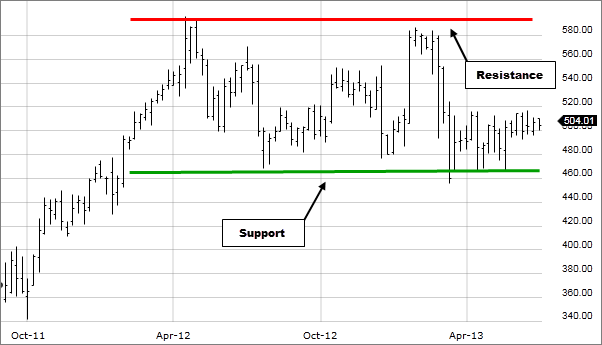
Support is a price level where a falling stock tends to stop and bounce back. This happens because more buyers step in as the price drops. Resistance is the opposite. It is a price level where a rising stock tends to stop because more sellers step in.
Moving Averages: SMA vs. EMA
A Moving Average is an indicator that shows the average value of a security’s price over a set period. It is used to smooth out price data to identify the trend direction. The two main types of moving averages are:
Simple Moving Average (SMA): A simple average of a security over a defined number of time periods.
Exponential Moving Average (EMA): Gives more weight to the most recent prices, and therefore reacts more quickly to price changes than the SMA.
Momentum Indicators (RSI and MACD)

These indicators measure how fast a price is moving. The Relative Strength Index (RSI) shows if a stock is overbought or oversold. The Moving Average Convergence Divergence (MACD) helps spot changes in a trend’s strength and direction.
Trading Volume and Trend Strength
Volume is the number of shares traded over a set time. It shows how strong a trend is. When prices rise and volume goes up, that confirms the trend is real. When volume drops, the trend may be losing steam.
Common Chart Patterns to Watch
Chart patterns are distinctive formations on the stock chart that create a trading signal, or a sign of future price movements. Chartists have identified many patterns that can signify either continuation or reversal signals. Some of the most common are:
Head and Shoulders: Indicates a reversal of a trend.
Triangles: Can be symmetrical, ascending, or descending and often signal a continuation of a trend.
Double Top and Bottom: Indicate reversals when the price reaches a certain level twice and can’t break through.
Putting It All Together

When using technical analysis, it’s important to remember that it’s more of an art than a science. Patterns and indicators are open to interpretation, and there is no one-size-fits-all approach. Here’s a simple step-by-step guide to get you started:
Identify the chart type you are most comfortable with.
Determine the trend and mark out the support and resistance levels.
Apply any relevant indicators to help you understand the momentum and volume.
Look for chart patterns that could indicate potential buy or sell signals.
Combine your findings with other forms of analysis, such as fundamental analysis, to make informed decisions.
Remember, no technical analysis tool is infallible. Always use stop-loss orders and only invest money you can afford to lose.

Free Registration for Stock Market Tips ( Advisory Services)
As per the SEBI rules, we will provide our Services only to those clients who have Complete Risk Profile. Fill This Registration Form and
Contact us on
- Whatsapp @ +91 95999 69624
- Call Us @ +91 9650 890 321
for further process.
Risk Profiling is COMPULSORY
Technical Analysis for Short-Term Trading: Key Concepts Explained
Technical analysis for short-term trading involves studying historical price data, chart patterns, and trading volume to predict future price movements over short time frames such as minutes, hours, or days. Traders use this approach to identify entry and exit points, relying on tools like candlestick charts, moving averages, support and resistance levels, and momentum indicators such as RSI and MACD. Unlike fundamental analysis, which evaluates a company's financial health, technical analysis focuses solely on price action and market data to make quick trading decisions.
What is technical analysis and how does it work for short-term trading?
Technical analysis is the study of past market data, primarily price and volume, to forecast future price movements. In short-term trading, it works by identifying recurring patterns and statistical trends that suggest where a stock price is likely to move next. Traders apply indicators, chart patterns, and trend lines to determine optimal entry and exit points within a short holding period.
Which technical indicators are best for short-term trading?
The most commonly used technical indicators for short-term trading include the Relative Strength Index (RSI) for measuring overbought or oversold conditions, the Moving Average Convergence Divergence (MACD) for identifying trend direction and momentum, and the Exponential Moving Average (EMA) which reacts quickly to recent price changes. Volume indicators also help confirm the strength of a price move.
How do you identify entry and exit points using technical analysis?
Entry points are often identified when the price approaches support levels, shows bullish candlestick patterns, or when indicators like RSI move out of oversold territory. Exit points are typically set near resistance levels, when bearish reversal patterns form, or when indicators signal overbought conditions. Stop-loss orders placed below key support levels help manage risk.
What chart patterns should short-term traders watch for?
Short-term traders commonly watch for chart patterns such as triangles (ascending, descending, and symmetrical) which signal trend continuation, and head and shoulders or double top and bottom patterns which indicate potential trend reversals. Candlestick patterns like doji, hammer, and engulfing patterns also provide actionable signals for short time frames.
- Can technical analysis guarantee profits in short-term trading?
- No, technical analysis does not guarantee profits. It improves the probability of making informed decisions, but all trading carries risk. Using stop-loss orders and proper position sizing is essential.
- What time frame works best for short-term technical analysis?
- Short-term traders often use 5-minute, 15-minute, 1-hour, or daily charts depending on their trading style. Scalpers use the shortest time frames, while swing traders may prefer daily charts.
- Do I need fundamental analysis for short-term trading?
- Fundamental analysis is not required for short-term technical trading, as price action and volume are the primary focus. However, combining both approaches can provide additional context for decision-making.
- How do moving averages help in short-term trading?
- Moving averages help smooth out price data to identify trend direction. The EMA is preferred over SMA for short-term trading because it reacts faster to recent price changes, providing earlier signals.
- What is the role of volume in technical analysis?
- Volume confirms the strength of a price move. Rising volume during an uptrend validates the trend, while declining volume may signal weakness. Volume indicators like On-Balance Volume (OBV) help traders assess buying and selling pressure.
- How do I learn technical analysis for short-term trading?
- Start by understanding basic chart types and trend identification, then learn key indicators like RSI, MACD, and moving averages. Practice on historical charts and use demo accounts before trading with real money.