Technical Indicators
Popular Technical Indicators Such As RSI, MACD, And Bollinger Bands And Their Application In Stock Market Analysis
Technical Indicators Can Be Your Crystal Ball?

Technical indicators are crucial tools for traders and investors looking to predict market movements.
📊 Relative Strength Index (RSI)

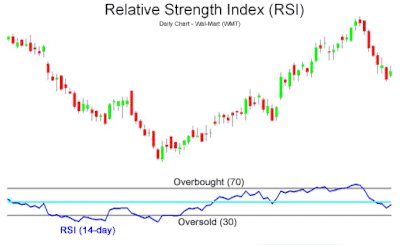
The RSI is a momentum oscillator that measures the speed and change of price movements. It oscillates between zero and 100 and is typically used to identify overbought or oversold conditions in a stock.
Relative Strength Index (RSI)
What is RSI?
The RSI is a momentum oscillator that measures the speed and change of price movements. It oscillates between zero and 100 and is typically used to identify overbought or oversold conditions.
Calculating RSI
To calculate RSI, you need to follow these steps:
- Calculate the average gain and average loss over a specified period, typically 14 days.
- Compute the relative strength (RS) which is the ratio of average gain to average loss.
- The RSI is then found using the formula: RSI = 100 – (100 / (1 + RS))
Interpreting RSI
- An RSI above 70 indicates a stock may be overbought.
- An RSI below 30 suggests it may be oversold.
- Divergences between RSI and price can indicate potential reversals.
Example: If the RS is
Overbought: An RSI above 70 suggests that a stock may be overbought and could be due for a pullback.
Oversold: An RSI below 30 indicates an oversold condition, potentially signaling a buying opportunity.
Example: If Reliance Industries Limited (NSE: RELIANCE) has an RSI of 75, it might be considered overbought, and traders could anticipate a price correction.
📈 Moving Average Convergence Divergence (MACD)
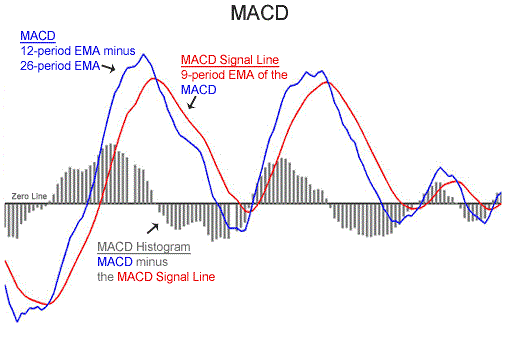
The MACD is a trend-following momentum indicator that shows the relationship between two moving averages of a stock’s price. It consists of the MACD line, signal line, and histogram.
MACD Line: The difference between the 12-day and 26-day exponential moving averages (EMAs).
Signal Line: The 9-day EMA of the MACD line.
Histogram: The difference between the MACD line and the Signal line.
Traders look for signal line crossovers, centerline crossovers, and divergences to generate signals.
Example: If the MACD line of Tata Motors Limited (NSE: TATAMOTORS) crosses above the signal line, it's considered a bullish signal, indicating it might be a good time to buy.
📉 Bollinger Bands

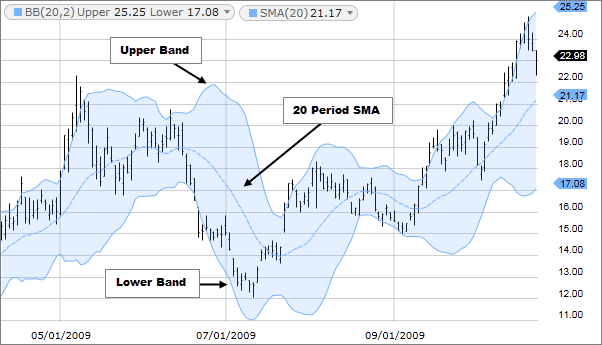
Bollinger Bands are a volatility indicator that consists of a middle band being a simple moving average (SMA) and two outer bands that are standard deviations away from the middle band.
Middle Band: Typically a 20-day SMA.
Upper Band: Middle band + (2 x standard deviation).
Lower Band: Middle band – (2 x standard deviation).
Stock prices tend to bounce within the bands, and traders often use them to determine overbought and oversold levels.
Example: If Infosys Limited (NSE: INFY) stock price moves above the upper Bollinger Band, it might be overbought, suggesting a potential sell signal.
🔍 Applying Technical Indicators

When applying technical indicators, it’s important to use them in conjunction with other forms of analysis and market context. Here’s how you can integrate them into your trading strategy:
Combine Indicators: Use more than one indicator to confirm signals. For instance, if RSI and MACD both indicate an overbought condition, the signal is stronger.
Look for Divergences: If the price is making new highs but an indicator like RSI is not, it could indicate weakening momentum.
Adjust Parameters: Tailor the parameters of the indicators (like the period of the SMA in Bollinger Bands) to suit your trading style and the stock’s volatility.
Remember, no indicator is foolproof. They should be used as tools to support your trading decisions, not as the sole basis for them. Always backtest your strategy with historical data before applying it to live markets.
Combining Indicators for Enhanced Analysis
📈📊🔔 Using RSI, MACD, and Bollinger Bands Together
While each indicator has its strengths, they can be most powerful when used in conjunction. For instance, if the RSI indicates overbought conditions, the MACD shows bearish crossover, and the price hits the upper Bollinger Band, it could be a strong signal that the stock is due for a correction.
Practice Makes Perfect
🎯 Test, Learn, and Adapt
It’s essential to practice using these indicators in a virtual trading environment before applying them with real money. Over time, you’ll learn how to interpret their signals in the context of the market’s mood and your investment strategy.
Short step-by-step plan:
- Technical Indicators:
- Explain what technical indicators are and their role in stock market analysis.
- Provide a brief overview of RSI, MACD, and Bollinger Bands and their significance.
- Relative Strength Index (RSI):
- Define RSI and its purpose in analyzing stock price movements.
- Provide an example of how RSI is used to identify overbought and oversold conditions in a stock, citing a real-life stock scenario.
- Exploring Moving Average Convergence Divergence (MACD):
- Explain the concept of MACD and its role in determining trend strength and direction.
- Use a stock chart to demonstrate how MACD crossovers can signal potential buy or sell opportunities.
- Application of Bollinger Bands:
- Describe Bollinger Bands and their function in measuring volatility and identifying potential price reversal points.
- Illustrate the use of Bollinger Bands in a specific stock’s historical data, showcasing how it can be used for entry and exit signals.
- Real Stories of Successful Technical Analysis:
- Share real-life examples of traders or investors who effectively utilized RSI, MACD, or Bollinger Bands to make informed decisions in the stock market.
- Discuss the outcomes and lessons learned from these examples.
- Saving Structure and Main Ideas:
- Summarize the key takeaways from the guide, emphasizing the practical application of RSI, MACD, and Bollinger Bands in stock market analysis.
- Organize the content in a clear and coherent manner, ensuring easy access to the main ideas and examples.
- Research each indicator:
- Example: Begin by researching how the Relative Strength Index (RSI) is calculated and its interpretation in identifying overbought or oversold conditions in a stock. Look for real-life examples of RSI being used to make trading decisions.
- Study MACD indicator:
- Example: Dive into the calculation of the Moving Average Convergence Divergence (MACD) and understand how it can signal changes in the strength, direction, momentum, and duration of a trend.

Free Registration for Stock Market Tips ( Advisory Services)
As per the SEBI rules, we will provide our Services only to those clients who have Complete Risk Profile. Fill This Registration Form and
Contact us on
- Whatsapp @ +91 95999 69624
- Call Us @ +91 82 7799 7560
for further process.
Risk Profiling is COMPULSORY
Stock Market Analysis and Predictions for 2025 Current Market Conditions The stock market is very volatile right now, causing worry among …
Popcorn Tax: Effects the Indian Economy The government of India has recently made the decision to increase the Goods and Services Tax …
Summary of India’s GDP Data Key Data Release An important GDP data release was scheduled post-market closure on November 29. This data …
Nifty Stock Market Analysis by EquityX 25-11-2024 Final Closing Details Nifty Closing Level: 23970 Friday’s Closing Gain: Nifty surged by 557 points. …
The Impact of Liquidity on Intraday Trading Strategies for Maximizing Returns Intraday trading, also known as day trading, involves buying and selling …
Mastering Intraday Equity Trading Top 10 Intraday Trading Tips for Success Intraday equity trading can be an exciting and profitable venture, but …
Strategies for Successful Intraday Equity Trading Intraday trading in the fast-paced world of equity markets can be both thrilling and challenging. With …
The Art of Using Stop-Loss Orders in Intraday Equity Trading Intraday equity trading can be a thrilling and potentially lucrative venture for …
Important Tools for Analyzing Intraday Equity Markets Intraday trading in equity markets can be thrilling and profitable, but it also requires a …
Share Market Tips For Beginners The share market, also known as the stock market, is a crucial component of the global financial …
What Are Macroeconomic And Market-Specific Risks Macro and Market Risks Macroeconomic and market-specific risks can significantly impact the financial performance of businesses …
What Are Risk Management Strategies In Stock Portfolio Risk Management Strategies: In the context of stock portfolio management, risk management refers to the process …
What Are Financial And Business Risks In Stock Investments Interesting Fact: financial and business risks are inherent in stock investments, and understanding …
Risk Assessment Not All Risks Are Equal? When it comes to investing in the Indian stock market, understanding and assessing risk is …
What Are Regulatory And Geopolitical Factors Influencing Stock Investments Regulatory Factors in Stock Investments Regulatory factors play a crucial role in influencing …
What Are Industry Trends And Competitive Positioning Of Companies Industry Trends and Competitive Positioning Analyzing industry trends and competitive positioning is crucial …
Assessing Management Quality And Corporate Governance Practices Interesting Fact: The quality of management and corporate governance practices can significantly impact a company’s …
Qualitative Analysis Companies Have Personalities? Just like people, every company has its own personality, which can be understood through Qualitative Analysis. This type …
What Is Price-To-Book (P/B) Ratio And How It Can Help In Evaluating Stock The Price-to-Book (P/B) Ratio The P/B ratio is a …
The Price-To-Earnings (P/E) Ratio And Its Significance In Stock The price-to-earnings (P/E) ratio and its significance in stock analysis The P/E ratio …
Discounted Cash Flow (DCF) Analysis And Its Application In Stock Valuation Discounted Cash Flow (DCF) Analysis Discounted Cash Flow (DCF) analysis is …
Valuation Techniques True Worth of a Company? Valuing a company is both an art and a science. Investors around the world use …
What are Undervalued And Overvalued Stocks Based On Fundamental Analysis Fundamental Analysis fundamental analysis is a method used to evaluate the intrinsic …
What are Economic Indicators And Their Impact On Stock Prices The stock market is influenced by a wide range of economic indicators? …
Financial Statement Analysis: Balance Sheet, Income Statement, And Cash Flow The balance sheet, income statement, and cash flow statement are the three …
Technical Analysis Indicators To Make Informed Investment Decisions Technical Analysis Indicators Technical analysis indicators are mathematical calculations based on historical price, volume, …
Technical Analysis Tools For Short-Term Stock Market Investment 📈 Candlestick Patterns Candlestick patterns are a crucial part of technical analysis. These patterns provide …
Technical Analysis For Short Term Trading Charts Can Tell Stories? Investing in the stock market is not just about picking stocks at …
What Are The Impact Of Market Trends On Stock Selection Market Trends and Their Impact on Stock Selection Market trends can significantly …