

What is SGX Nifty and How it Influence Indian Stock Market
SGX Nifty, also known as the Singapore Nifty, is a futures contract based on the National Stock Exchange of India's (NSE) Nifty 50 index. It is traded on the Singapore Exchange (SGX) and provides investors with an opportunity to speculate on the direction of the Indian stock market before it opens. SGX Nifty is a popular derivative product that allows investors to gain exposure to the Indian market without having to physically trade on the NSE. The purpose of SGX Nifty is to provide investors with a tool to hedge their positions or take speculative positions on the Indian stock market.
It allows investors to take advantage of price movements in the Nifty 50 index even when the Indian market is closed. This is particularly useful for international investors who may not have access to trade on the NSE during their local trading hours. SGX Nifty provides them with a way to participate in the Indian market and manage their risk effectively.
Indian Stock Exchanges NSE & BSE
The Indian stock market consists of two major exchanges, namely the BSE and the NSE ( National stock exchange ) & BSE the Bombay Stock Exchange (BSE), These are one of the largest and most active stock markets in the world. The BSE is the oldest stock exchange in Asia, while the NSE is the largest in terms of trading volume.

How SGX Nifty is calculated and its importance
SGX Nifty is calculated based on the Nifty 50 index, which is a benchmark index of the NSE. The Nifty 50 index represents the performance of the top 50 companies listed on the NSE and is widely used as a barometer of the Indian stock market. The calculation of SGX Nifty takes into account the prices of these 50 stocks and their respective weights in the index.

The relationship between SGX Nifty and Indian stock market
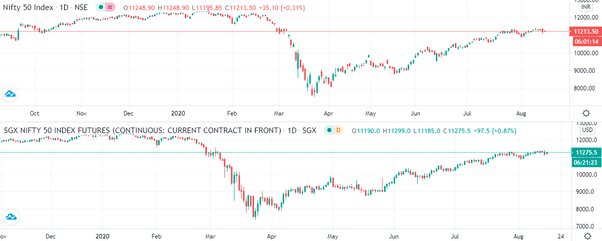
There is a strong correlation between SGX Nifty and the Indian stock market. This means that movements in SGX Nifty are often reflected in the Indian market when it opens. If SGX Nifty indicates a positive opening, it is likely that the Indian market will also open on a positive note, and vice versa.
SGX Nifty as an indicator of market sentiment

When SGX Nifty trades higher, it signals positive market sentiment. Investors expect good things from the Indian market. When SGX Nifty trades lower, it signals negative sentiment. Investors are cautious or worried.
Market sentiment matters for Nifty futures trading strategies and investing. Positive sentiment can drive buying and push prices up. Negative sentiment can lead to selling and push prices down.
The impact of global events on SGX Nifty and Indian stock market
Positive events, like strong economic data from major countries, boost investor confidence. This lifts SGX Nifty and Indian markets. Negative events, like geopolitical tensions or global downturns, create uncertainty. This can push SGX Nifty down and weaken Indian markets.
Major global events that affected SGX Nifty and Indian markets include the 2008 financial crisis, the 2011 European debt crisis, and the 2020 COVID-19 pandemic. All three caused sharp moves in SGX Nifty and Indian stocks.
How traders and investors use SGX Nifty for their strategies
Common strategies include trend following (trading in the same direction as SGX Nifty) and breakout trading (trading when SGX Nifty breaks a price range). Traders also use tools like moving averages and support-resistance levels to spot opportunities.
For investors, SGX Nifty helps with portfolio planning. By watching SGX Nifty, they can guess how Indian markets may perform and adjust their holdings. For example, if SGX Nifty points to a weak opening, an investor might sell some stocks or buy more bonds.
The controversy surrounding SGX Nifty and its effect on Indian markets
Another issue involves the licensing agreement between NSE and SGX. In 2018, the NSE ended its deal with SGX, which stopped SGX from offering Nifty 50 futures. The NSE did this to protect its market share and bring trading back to India.
After the deal ended, trading volumes on SGX Nifty dropped. Activity moved back to the NSE. This affected liquidity and price discovery in Indian markets.
The future of SGX Nifty and its potential changes
One option is a new licensing deal between NSE and SGX. This could come with stricter rules, such as higher margin needs or trading limits. This would help keep more trading activity in India.
Another option is the creation of new products. Other exchanges could offer futures on Indian indexes besides the Nifty 50. This would give investors more ways to trade Indian stocks without relying only on SGX Nifty.
What happens next will depend on talks between NSE, SGX, and other parties. The goal will be to balance investor access with Indian market stability.
SGX Nifty as a vital tool for understanding the Indian share market
Traders and investors use SGX Nifty in many ways, from trend following to portfolio hedging. But controversies have raised questions about its effect on market liquidity. The future of SGX Nifty will depend on new rules and agreements.
Despite the debates, SGX Nifty remains a useful tool for understanding stock market fundamentals. It gives investors insights into market sentiment and possible price moves. It helps them make informed choices and manage risk. For those seeking exposure to Indian markets, SGX Nifty is still an important product. To learn more about options trading in the Indian market, check out options performance articles on EquityX.in for helpful data and insights.

Free Registration for Stock Market Tips ( Advisory Services)


As per the SEBI rules, we will provide our Services only to those clients who have Complete Risk Profile. Fill This Registration Form and
Contact us on
- Whatsapp @ +91 95999 69624
- Call Us @ +91 9650 890 321
for further process.
Risk Profiling is COMPULSORY
Everything You Need to Know About SGX Nifty
SGX Nifty is a futures contract based on the Nifty 50 index that trades on the Singapore Exchange (SGX). It provides an early indication of how the Indian stock market is likely to perform when trading opens on the National Stock Exchange (NSE). Because SGX Nifty trades during hours when the Indian market is closed, it reflects global events and overnight developments that can affect Indian stocks.
What is SGX Nifty?
SGX Nifty is a derivative product that allows investors to trade the Nifty 50 index outside of Indian market hours. It is settled in cash and tracks the same 50 stocks that make up the Nifty 50 index on the NSE. The contract is denominated in US dollars, making it accessible to international investors who want exposure to Indian equities without trading directly on Indian exchanges.
How does SGX Nifty influence the Indian stock market opening?
SGX Nifty influences the Indian market opening by acting as a price discovery mechanism during non-trading hours. If SGX Nifty trades higher during the overnight session, the Nifty 50 on the NSE often opens higher. If SGX Nifty trades lower, the Indian market tends to open weaker. This relationship exists because both instruments track the same underlying index and reflect similar investor sentiment.
Why do traders watch SGX Nifty before the NSE opens?
Traders watch SGX Nifty before the NSE opens because it provides real-time information about how global events have affected expectations for Indian stocks. Since the Indian market is closed during major international trading sessions, SGX Nifty fills the gap by showing where the index would trade if it were open. This helps traders plan their opening strategies, set limit orders, and manage risk before the first trade on the NSE.
Frequently Asked Questions About SGX Nifty
- What is SGX Nifty in simple terms?
- SGX Nifty is a futures contract on India's Nifty 50 index that trades on the Singapore Exchange. It lets investors trade Indian stocks during hours when the Indian market is closed.
- How is SGX Nifty different from Nifty 50?
- SGX Nifty is a futures contract traded on the Singapore Exchange, while Nifty 50 is the actual stock index on the National Stock Exchange of India. SGX Nifty tracks the Nifty 50 but trades at different hours and is settled in US dollars.
- Does SGX Nifty predict the Indian market direction?
- SGX Nifty provides a useful signal but does not guarantee the Indian market opening level. It reflects global sentiment and overnight developments, but local factors at the opening bell can still move the market differently.
- What factors move SGX Nifty during overnight trading?
- Global macroeconomic data, US market movements, geopolitical events, commodity price changes, and currency fluctuations are the main factors that move SGX Nifty during overnight trading sessions.
- How can retail investors use SGX Nifty information?
- Retail investors can check SGX Nifty prices before the market opens to gauge market sentiment and adjust their trading or investment decisions. It helps in setting price targets and stop-loss levels for the trading day.
- Is SGX Nifty regulated?
- SGX Nifty is regulated by the Monetary Authority of Singapore (MAS) since it trades on the Singapore Exchange. The underlying Nifty 50 index is owned and managed by NSE Indices Limited in India.