
Crude Oil Intraday Trading on MCX: Timings, Volatility and Risk
When MCX crude oil trades, when the big moves come in India time, why it gaps at the open, and how to size every trade from the stop-loss.
Key takeaways
- MCX crude oil trades from 9:00 am to 11:30 pm. From about November to March, when the US is on winter time, it stays open till 11:55 pm.
- The biggest moves usually come in the evening, India time, when US data, the weekly EIA oil report and US Fed decisions come out.
- News that comes while MCX is closed shows up as a gap at the 9 am open, and a gap can jump past your stop-loss.
- Fix your rupee loss first (1% to 2% of capital), then choose Crude Oil Mini or Crude Oil and the number of lots.
01MCX crude oil timings: 9 am to 11:30 pm or 11:55 pm
MCX crude oil futures trade Monday to Friday. The normal session starts at 9:00 am. It ends at 11:30 pm for most of the year, and at 11:55 pm from about November to March. Before the open, 8:45 to 8:59 am is a short session only for cancelling pending orders.
Why does the closing time change? MCX crude oil is linked to the US benchmark, WTI crude oil traded on NYMEX. At expiry, MCX settles the contract on the NYMEX price converted at the RBI rupee-dollar rate. India does not change its clocks, but the US does. When US daylight saving ends in early November, US trading hours fall later in India time, so MCX keeps crude open 25 minutes longer. MCX confirms each switch by circular.
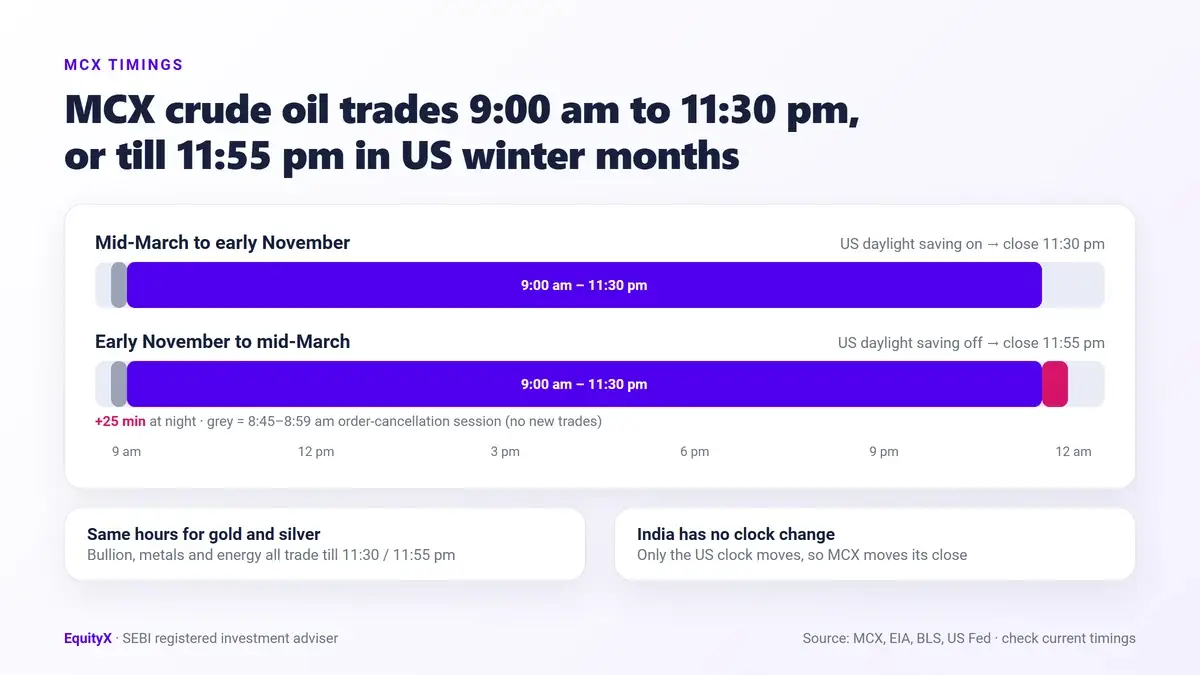
Gold, silver and the other metals follow the same hours. Most agri commodities close at 5 pm.
A long session does not mean you have to trade all of it. Most of our MCX crude oil intraday calls and other MCX calls come between 9 and 11 am, and every position is closed the same day, so you do not need to sit up for the late-night news.
Source: MCX Trading & Surveillance (trade timings) and MCX contract specifications for Crude Oil and Crude Oil Mini, checked on 7 Nov 2026.
02When crude oil moves most (India time)
Crude oil reacts to supply news and to the US economy. MCX itself lists OPEC supply, US crude oil stocks, refinery use, global politics and weather among the things that move the price. Most of this news comes out during US hours, which is evening and night in India.
| Event | When (US time) | IST, Nov to Mar | IST, Mar to Nov |
|---|---|---|---|
| EIA Weekly Petroleum Status Report (US crude oil and fuel stocks) | Wednesday, 10:30 am US Eastern time. In some US holiday weeks it moves, usually to Thursday. | 9:00 pm | 8:00 pm |
| US jobs report and US inflation (CPI) | Once a month, 8:30 am US Eastern time | 7:00 pm | 6:00 pm |
| US Federal Reserve rate decision | 8 meetings a year, statement at 2:00 pm US Eastern time | 12:30 am (after MCX closes) | 11:30 pm (as MCX closes) |
| OPEC and OPEC+ decisions | No fixed time; meetings can fall on a weekend | Any time | Any time |
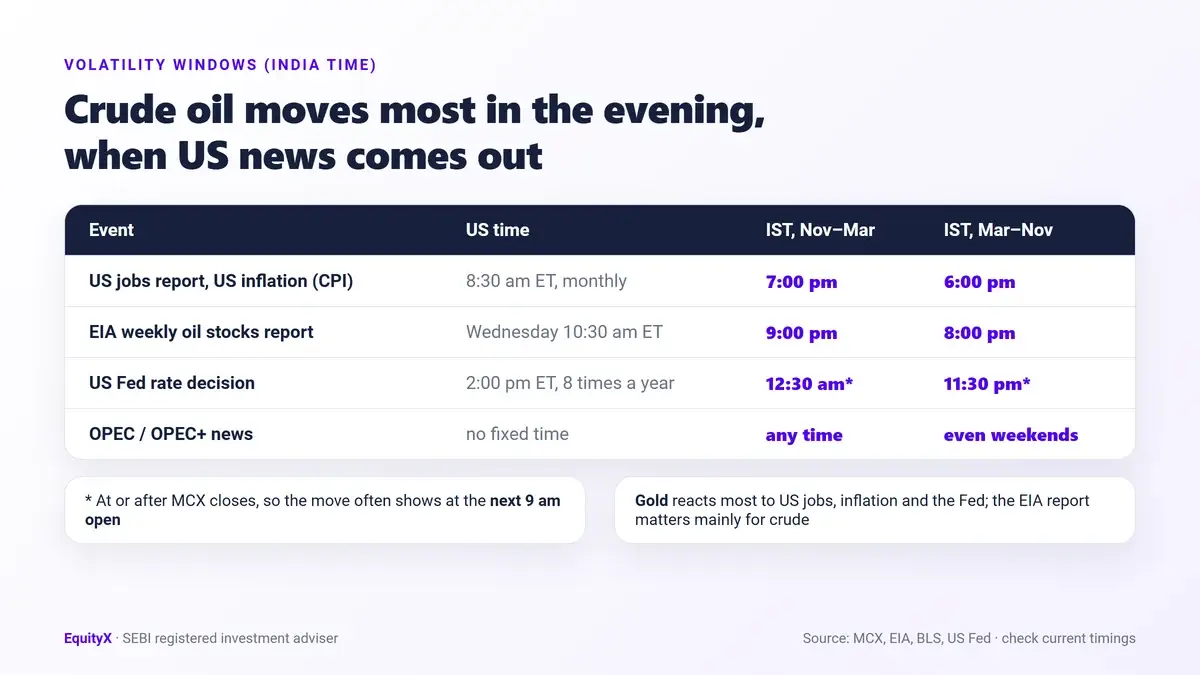
Around these times the price can jump many points in a minute or two, and the gap between buy and sell prices gets wider. A stop-loss order may fill at a worse price than you set. If you trade crude in the evening, check the week’s calendar first and decide before you enter whether you want to be in a trade at 9 pm on Wednesday.
Indian mornings fall in US night hours, when there is little scheduled US news. Crude still moves on Asian demand, the rupee and any overnight headline, so the stop-loss rule does not change.
Sources: EIA weekly report schedule, US Bureau of Labor Statistics release schedule, US Federal Reserve FOMC calendar.
03Why crude oil gaps at the 9 am open
MCX is shut from 11:30 pm or 11:55 pm till 9 am, and over the weekend. World crude oil trading and the news do not stop. A Fed decision at 12:30 am, an OPEC+ statement on a Sunday or a sudden supply problem gets priced in abroad first. When MCX opens, crude jumps straight to the new level. That jump is a gap.
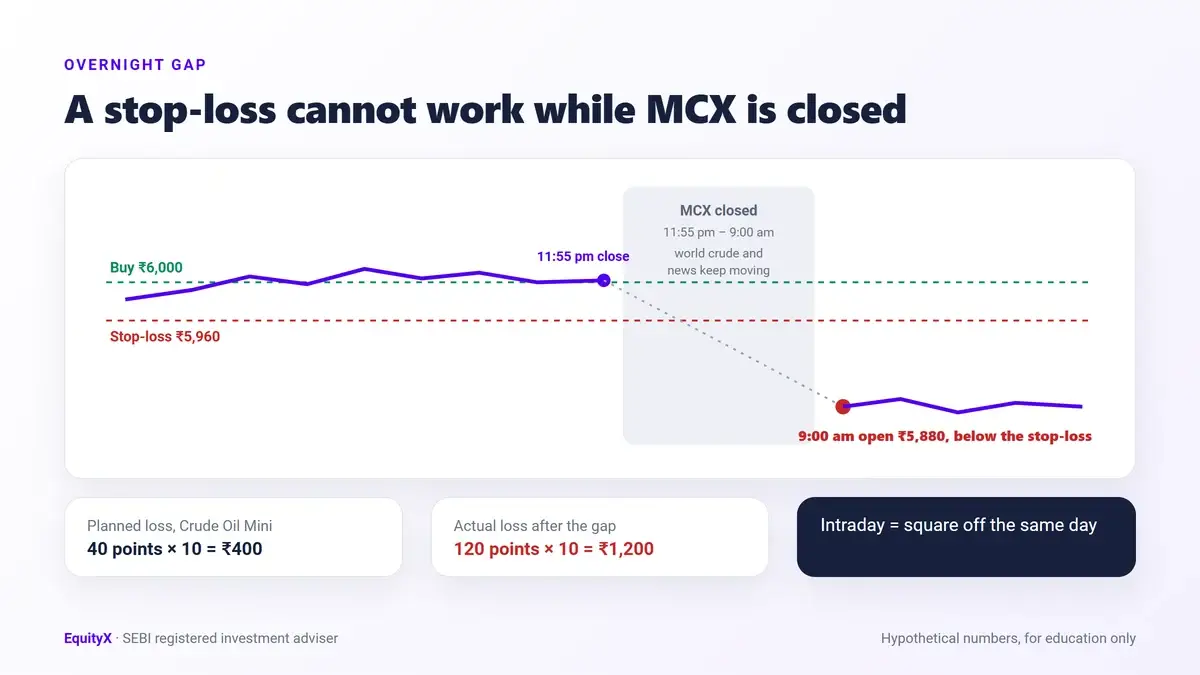
A stop-loss is an order that waits for a price. If the market opens beyond your stop-loss, the order fills at the first available price, not at your stop. In the example above, a planned 40-point loss turns into a 120-point loss: ₹1,200 on one Crude Oil Mini lot instead of ₹400.
MCX also has daily price limits for crude oil: a first band of 4%, which can be relaxed to 6% and then 9%, and further in steps of 3% if world prices move more. On crude at ₹6,000, 4% is 240 points. Big moves within one day are part of this market.
The simple rule for an intraday trader: square off the same day. A trade that is closed at night cannot be hit by a morning gap.
04How margin works for crude oil
Margin is the deposit your broker blocks so you can hold a futures position. It is not the size of the trade. For MCX crude oil, the initial margin is at least 10% of the contract value or the SPAN figure, whichever is higher, plus an extreme loss margin of at least 1%. When crude turns very volatile, the exchange can add extra margin on top.
Contract value = price × barrels in one lot. Crude Oil is 100 barrels and Crude Oil Mini is 10 barrels. Both are quoted in rupees per barrel and move in steps of ₹1.
| Contract | One lot | ₹1 move per lot | Contract value at ₹6,000 | Margin if 30% (assumed) |
|---|---|---|---|---|
| Crude Oil Mini | 10 barrels | ₹10 | ₹60,000 | ₹18,000 |
| Crude Oil | 100 barrels | ₹100 | ₹6,00,000 | ₹1,80,000 |
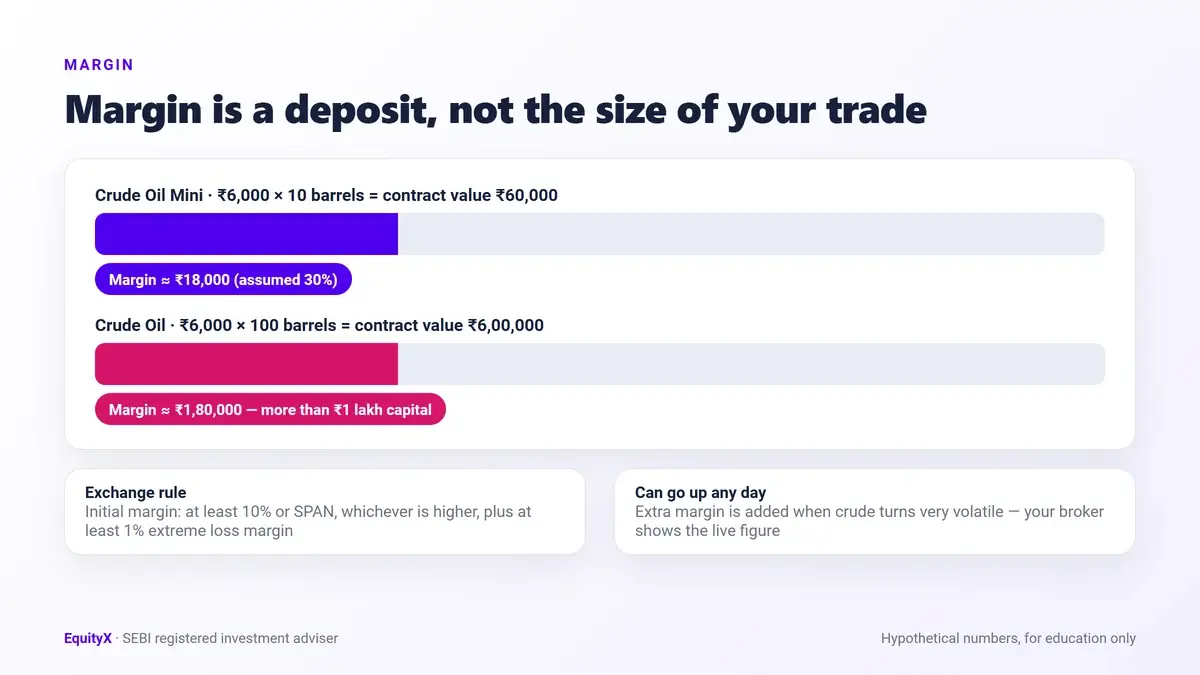
Two things follow. First, your gain or loss is on the full contract value, not on the margin. A 1% move on crude at ₹6,000 is 60 points, which is ₹6,000 on one Crude Oil lot. Second, brokers collect the margin upfront and settle losses every day, so keep money beyond the margin as a cushion. The MCX lot size calculator shows contract value and tick value at today’s price.
Margin rules from the MCX contract specifications (7 Nov 2026). Price and the 30% margin are assumed, only to explain the idea. Your broker shows the live margin.
05Stop-loss and position size: keep each trade to 1–2% of capital
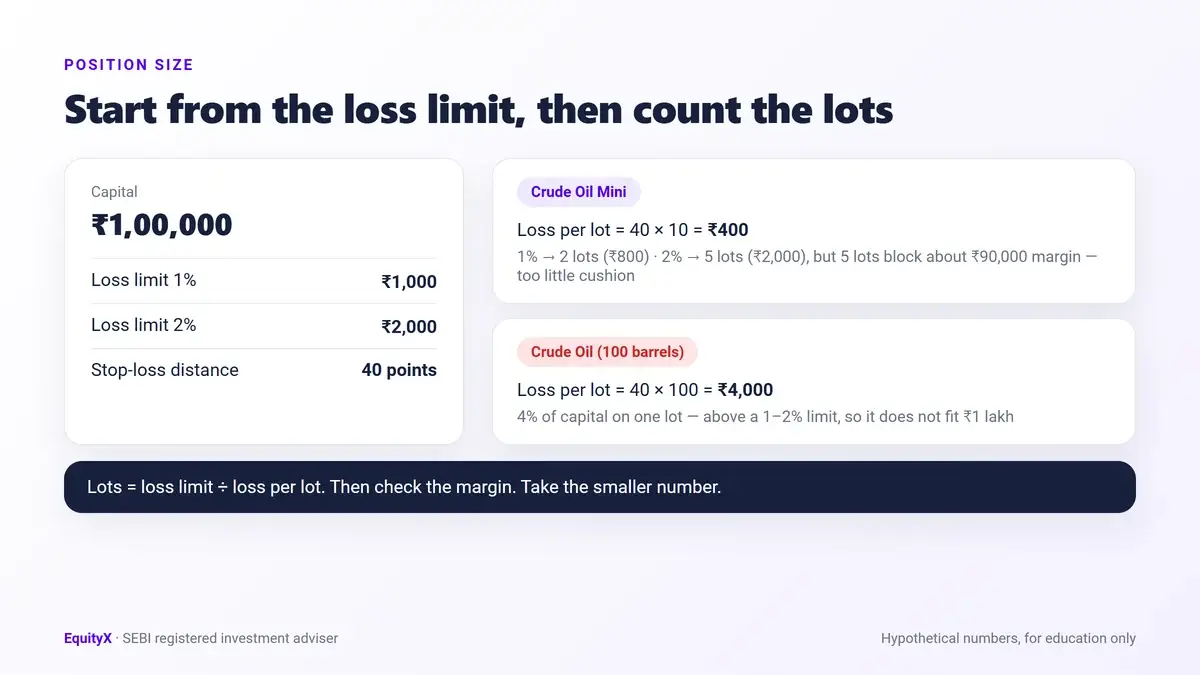
A common rule is to cap the loss on any one trade at 1% to 2% of capital. On ₹1,00,000, that is ₹1,000 to ₹2,000. Work backwards from that number:
- Place the stop-loss where the trade idea is proved wrong, not where the loss feels small.
- Loss per lot = stop-loss distance in points × barrels in one lot.
- Lots = your loss limit ÷ loss per lot. Round down.
- Check that the margin for those lots still leaves a good cushion. Take the smaller number.
| Stop-loss distance | Loss per Crude Oil Mini lot | Mini lots within 1% of ₹1 lakh | Loss per Crude Oil lot | One Crude Oil lot, % of ₹1 lakh |
|---|---|---|---|---|
| 20 points | ₹200 | 5 lots | ₹2,000 | 2% |
| 40 points | ₹400 | 2 lots | ₹4,000 | 4% |
| 60 points | ₹600 | 1 lot | ₹6,000 | 6% |
| 80 points | ₹800 | 1 lot | ₹8,000 | 8% |
Then the margin check: at 20 points the 1% limit allows 5 Mini lots, but 5 lots block about ₹90,000 of margin (at the assumed 30%), which leaves almost no cushion. So the margin check cuts the number down.
With ₹1,00,000, one full Crude Oil lot with a 40-point stop-loss already puts 4% of capital at stake. That is why smaller accounts trade Crude Oil Mini. Our guide to MCX mini and micro contracts compares Gold Mini, Silver Mini and the other small lots, and the intraday risk management guide covers stop-loss placement in more detail.
Two rules never change: do not widen a stop-loss after you enter, and do not add lots to a losing trade.
06Gold on MCX: same hours, different triggers
Gold trades on MCX in the same session as crude oil, from 9 am to 11:30 pm or 11:55 pm. Like crude, it reacts strongly to US jobs data, US inflation and Fed decisions, so the same evening windows matter. The EIA report is mainly a crude oil event. Gold on MCX also moves with the rupee-dollar rate.
The risk rules are the same: a fixed loss limit, a stop-loss placed as soon as you enter, and smaller contracts such as Gold Mini, Gold Ten or Gold Petal when capital is limited.
Our commodity advisory for gold, silver and crude oil uses these small contracts, with a minimum capital of ₹1 lakh. Every call comes with an entry, a stop-loss and three targets, and the quantity is calculated for your capital. See plans and pricing for the options.
07Crude oil intraday mistakes to avoid
?Crude oil intraday: FAQs
Why does MCX crude oil close at 11:55 pm in winter?
MCX crude oil follows the US benchmark, WTI crude oil. India does not change its clocks, but the US does. When US daylight saving time ends, usually in early November, MCX keeps the session open till 11:55 pm instead of 11:30 pm. It goes back to 11:30 pm when US daylight saving starts again in March.
What is the best time for crude oil intraday trading?
There is no single best time. The biggest moves come in the evening, India time, around US data and the Wednesday EIA report, and those are also the times of sudden jumps. Mornings have less scheduled US news. Pick a window you can watch fully, and keep a stop-loss in every trade.
What time is the EIA crude oil inventory report in India?
The EIA Weekly Petroleum Status Report usually comes out on Wednesday at 10:30 am US Eastern time. That is 9:00 pm IST from about November to March and 8:00 pm IST for the rest of the year. In some US holiday weeks it moves, usually to Thursday.
How much capital do I need for crude oil intraday trading?
Enough to cover the margin with a cushion, and a stop-loss that keeps the loss on one trade within 1% to 2% of capital. With ₹1 lakh, one full Crude Oil lot is usually too big, so smaller accounts use Crude Oil Mini (10 barrels). Our MCX plan uses small contracts and needs a minimum capital of ₹1 lakh.
Why does crude oil open with a gap on MCX?
MCX is closed from late night till 9 am and on weekends, but world crude oil trading and the news continue. When MCX opens, the price moves straight to the new level. If that level is beyond your stop-loss, the order fills at the first available price, so the loss can be bigger than planned.
Can anyone promise profit in crude oil intraday trading?
No. Crude oil moves fast, and some trades will hit the stop-loss. No SEBI registered adviser can promise returns. What you can control is the size of each loss.
This article is for education only and is not investment advice. All prices, margins and lot counts are hypothetical and shown only to explain the concepts. Timings and contract details can change; check the latest MCX circulars. Investment in securities market is subject to market risks. Read all related documents carefully before investing. EquityX is a SEBI registered Investment Adviser (Reg. No. INA100011775).