
Intraday Capital: ₹1 Lakh vs ₹3 Lakh vs ₹5 Lakh, What Changes
Which segments fit each capital level, when stock futures open up, and how to choose a plan without stretching your money.
Key takeaways
- A 1% to 2% loss limit on each trade stays the same at every capital level. What changes is the rupee amount and how many segments you can follow properly.
- ₹1 lakh suits one segment. ₹3 lakh can take two, and stock futures open up. ₹5 lakh and above can follow all five segments.
- More capital does not mean better results. It means more choice, and bigger rupee losses when a trade goes wrong.
- Capital bands are suggestions. Your final plan depends on your risk profile and suitability assessment.
01What changes with capital, and what does not
Many traders think more capital only means a bigger trade. In intraday trading it changes something more useful: how many segments you can follow properly, and which segments make sense at all.
| Your capital | Plan we suggest | Segments | Calls on a trading day | Stock futures | Fee (plus 18% GST) |
|---|---|---|---|---|---|
| ₹1 to 3 lakh | Signal | Any 1 | 1 to 2 | No | ₹12,000 a quarter or ₹36,000 a year |
| ₹3 to 5 lakh | Core | Any 2 | 1 to 3 per segment | Yes | ₹75,000 a year |
| ₹5 lakh and above | Pro | All 5 | All calls, no cap | Yes | ₹1,20,000 a year |
| ₹10 lakh and above | Elite | All 5 | All calls, no cap | Yes | ₹1,51,000 a year |
You can see the full comparison on our plans by capital page. These bands are our suggestion. The final plan depends on your risk profile and suitability assessment.
Some things do not change at any capital level:
- Every trade needs a stop-loss.
- A common rule is to keep the loss on one trade within 1% to 2% of capital. Which figure suits you depends on your risk profile.
- An intraday position is closed the same day.
- Some days have no clear setup, and then there may be no call.
If your capital is below ₹1 lakh, we suggest building it to ₹1 lakh first. Until then, you can follow free market insights on our Telegram channel and learn the basics.
02With ₹1 lakh: pick one segment and learn it well
At ₹1 lakh, a 1% to 2% limit means ₹1,000 to ₹2,000 on one trade. That is a small amount to spread around, so one segment makes more sense than three. You get to know how it behaves, and you are not watching several screens at once.
The Signal plan is built for this. You choose any one segment and get 1 to 2 calls on a trading day. The choice is usually between these:
- Options. Our Nifty and Bank Nifty options calls need only the premium times the quantity. But a premium can fall to zero, so use only money you can afford to lose.
- Cash market. Our intraday cash market calls suit beginners and medium-risk traders. You buy and sell shares the same day, and there is no expiry date to think about.
- MCX. Our MCX calls in gold, silver and crude oil use small contracts, so traders with ₹1 lakh can follow them with a proper stop-loss.
- Short term. These positions are held for more than one day, unlike intraday.
Pick the segment you can give time to. In Signal and Core, your segments stay locked, so you cannot jump to whichever one looks exciting that week. That is deliberate.
03With ₹3 lakh: a second segment, and stock futures open up
At ₹3 lakh you have enough room for two segments. Two segments help on days when one of them stays quiet. For example, options may stay in a range while MCX is moving.
The other big change is stock futures. A futures contract is much larger than the margin you put up, and a wrong move is felt on the full contract value. We suggest about ₹3 lakh for stock futures, and they start from the Core plan. This is a suitability decision, not a pricing one. Our guide to stock futures lot size and margin explains why the capital needed is higher.
Core gives you any two segments, 1 to 3 calls a day in each, one 15-minute call with the adviser every month, and personal WhatsApp support.
One caution: two segments can mean two open trades at the same time. The loss limit on each trade may be fine, but the total at stake on that day is higher. Be ready for that before you add a segment.
04With ₹5 lakh and above: all segments, every call
At ₹5 lakh and above, you no longer have to pick. Some days options stay in a range while the cash market or MCX moves. With all segments, you see every setup we publish that day.
The Pro plan covers all five segments: Nifty and Bank Nifty options, cash market, MCX, stock futures and short term. You get every call, with no daily cap, two 15-minute calls with the adviser every month, and priority WhatsApp support. One annual plan covers everything, so you do not have to renew or switch segments every quarter. With ₹10 lakh and above, Elite adds a dedicated relationship manager.
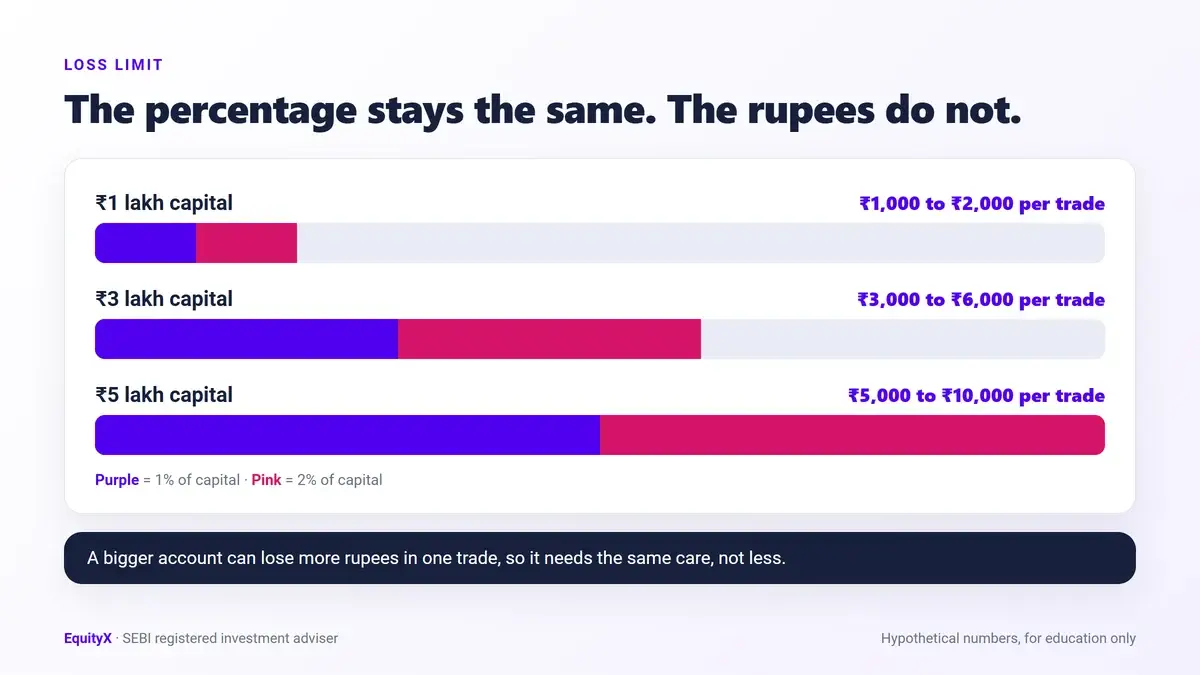
| Capital | 1% of capital | 2% of capital |
|---|---|---|
| ₹1,00,000 | ₹1,000 | ₹2,000 |
| ₹3,00,000 | ₹3,000 | ₹6,000 |
| ₹5,00,000 | ₹5,000 | ₹10,000 |
These are upper limits for one trade, shown only to explain the idea. The quantity on each call is worked out for each client.
Larger capital also needs more care in sizing each trade. Our separate guide on how position sizing changes with larger capital covers that side. The rest of this article is about which plan and segments to choose.
05Count the fee as a real cost
An advisory fee comes out of the same money you trade with. So compare it with your capital before you decide, and do not stretch to a bigger plan just because it has more features.
| Plan | Yearly fee | At the start of the band | At the top of the band |
|---|---|---|---|
| Signal | ₹36,000 | 36% of ₹1,00,000 | 12% of ₹3,00,000 |
| Core | ₹75,000 | 25% of ₹3,00,000 | 15% of ₹5,00,000 |
| Pro | ₹1,20,000 | 24% of ₹5,00,000 | 12% of ₹10,00,000 |
The share is highest at the start of each band, and this is most visible at ₹1 lakh. Signal also has a quarterly option of ₹12,000. If the fee looks large against your capital, stay with the smaller plan. All fees are plus 18% GST. SEBI permits a maximum of ₹1,51,000 per family per year. See plans and pricing for what each plan includes.
Not sure which segment suits you? The 7-day subscription costs ₹1,499 plus GST and covers all segments for 7 calendar days. One PAN can take it once. If you take a plan within those 7 days, the ₹1,499 is adjusted in full against it.
06What stays the same: the call format
Whatever your capital, a call has the same parts: an entry level, a stop-loss, targets and your quantity. The difference is that the quantity is worked out from the capital and risk level in your risk profile, so you do not have to calculate it yourself.
Every call also tells you the margin it needs and the capital it suits, and it reaches you on the EquityX web app and Telegram.
If you are new to us, you can read more about EquityX intraday advisory. Before any advice starts, every client completes KYC, a risk profile and a signed agreement.
07Mistakes to avoid when you choose by capital
?Capital and plans: FAQs
Which plan is right for ₹1 lakh capital?
Signal. You choose one segment: Nifty and Bank Nifty options, the cash market, MCX or short term. You get 1 to 2 calls on a trading day, each with your quantity. ₹1 lakh is the minimum capital we suggest.
Which plan is right for ₹3 lakh capital?
Core suits ₹3 to 5 lakh. You choose any two segments, and stock futures open up. You get 1 to 3 calls a day in each segment and one 15-minute call with the adviser every month.
Which plan is right for ₹5 lakh capital?
Pro. It covers all five segments and every call we publish, with no daily cap, plus two adviser calls a month and priority WhatsApp support. The final plan still depends on your risk profile.
Can I trade stock futures with ₹1 lakh?
Our stock future calls start from the Core plan, and we suggest about ₹3 lakh for them. Stock futures carry a higher risk, so they are not part of Signal.
Can I move to a higher plan later?
Yes. You can upgrade during your plan, and the unused part of your current plan is adjusted against the new plan.
Is there a monthly plan?
No. The shortest plan is Signal for one quarter. If you want to see the calls first, there is a 7-day subscription for ₹1,499 plus GST covering all segments.
Will more capital give me more profit?
No. More capital only means the same percentage gain or loss is a bigger rupee amount. Some trades will hit the stop-loss at any capital level, and no SEBI registered adviser can promise returns.
Keep reading
This article is for education only and is not investment advice. All loss limits, prices and examples are hypothetical and shown only to explain the concepts. Plan details and fees can change; check the current plans page. Investment in securities market is subject to market risks. Read all related documents carefully before investing. EquityX is a SEBI registered Investment Adviser (Reg. No. INA100011775).