
Share Market for Working Professionals: Intraday vs Short Term vs Positional
If you have a job, your real limit is time. Here is what each trading style asks of your day, and how to choose one you can actually follow.
Key takeaways
- Before you compare styles, work out when you are actually free. That decides more than anything else.
- Intraday is closed the same day, so there is no overnight risk. But it needs your attention at set times, and most options and MCX calls come in the first two hours.
- Short term trades are held for days, so they need little screen time. The cost is overnight risk: a stock can open below your stop-loss.
- Positional usually means an even longer hold. The names are used loosely, so check the holding period, not the label.
01Start with the clock, not the strategy
Most comparisons of trading styles start with returns. If you have a full-time job, start with your working day instead. Stocks and index options on the NSE trade from 9:15 am to 3:30 pm, Monday to Friday, and most salaried people are at work for all of it.
So the first question is simple: in those hours, when can you give a few minutes to a trade without neglecting your work? If the honest answer is "almost never", intraday is not for you right now, and that is fine.
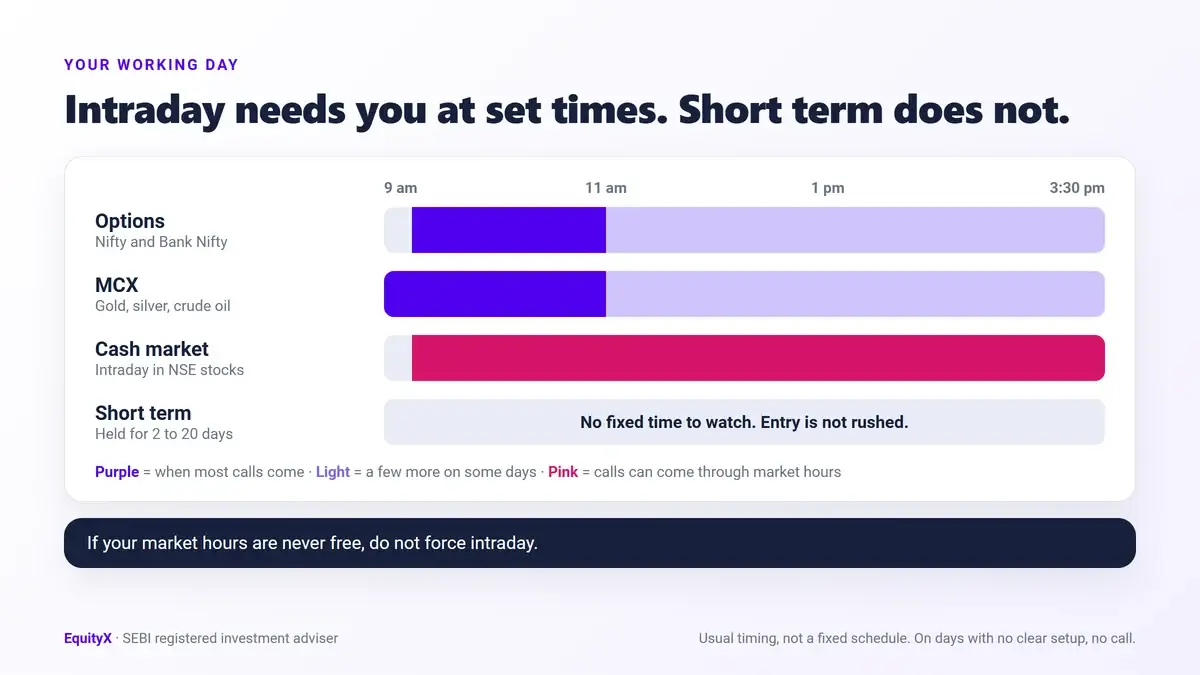
Intraday does not mean staring at a screen all day. It does mean being free when a call comes, free again right after you enter so you can place the stop-loss, and available to close the trade the same day.
02Intraday, short term and positional in plain words
- Intraday. You buy and sell on the same day. Nothing is carried to the next day.
- Short term. You hold for a few days to a few weeks. Many people call this swing trading.
- Positional. You hold until the expected move plays out. It usually means a longer hold than short term, often weeks or more.
These names are not fixed, and different people mean different things by them. Our own short term plan gives positional calls planned for 2 to 20 days. So always look at the holding period, not the label.
| Intraday | Short term | Positional | |
|---|---|---|---|
| Held for | Closed the same day | A few days to a few weeks | Often weeks or more |
| Attention needed | At set times in market hours | Little screen time, but read the updates | Less often, but more events to sit through |
| Overnight risk | None | Yes, a stock can gap | Yes, and for longer |
| Your money | Free again the same day | Tied up until you exit | Tied up for longer |
| The hard part | Being free when it matters | Staying calm through a gap | Patience, and news such as results |
03Intraday: our core work, if your day allows it
Intraday has one big advantage for someone with a salary. Every position is closed the same day, so you go to sleep with no open trade and no overnight risk.
The honest part is the attention it needs. It can fit if your working day leaves market hours free. For example:
- You work night shifts or rotating shifts.
- Your weekly off falls on a weekday.
- Your hours are flexible and your work starts later in the day.
We do not suggest trading in time your employer is paying you for. A trade placed between two meetings is usually a trade placed badly.
If one of these fits you, each segment asks for something different:
- Cash market. Our intraday cash market calls suit beginners and medium-risk traders. There is no lot size and no expiry, which is why we suggest cash before futures and options. Calls can come through market hours.
- Options. Most of our Nifty and Bank Nifty options calls come between 9:15 and 11 am. Premiums move fast and can fall to zero, so this needs the closest attention of all.
- MCX. The market stays open late at night, so many people assume it suits office-goers. But most of our MCX calls in gold, silver and crude oil come between 9 and 11 am, so you still need your morning.
Every call is a "buy above" or "sell below" level that the price has not reached when we send it. This usually gives you a few minutes to place your order calmly. If you only see the call much later, let it go. Chasing a level you have missed is not the same trade. You can read more about EquityX intraday advisory and how a trading day works with us.
04Short term: the alternative if you cannot watch screens
If your market hours are simply not free, short term is the alternative. Our short term stock advisory is made for working professionals and anyone who cannot sit in front of a screen during the market day. Here is how it works:
- Calls are in NSE cash market stocks only, taken as delivery. There are no futures or options, so no lot size and no expiry.
- You get about 2 to 10 calls in a month, each planned for a holding period of 2 to 20 days.
- Each call has an entry, three targets, one stop-loss and your quantity, and it reaches you on the web app and Telegram.
- Entry is not rushed. You can place the order from your trading app or through your broker.
- The minimum capital is ₹1 lakh. We suggest ₹5 to 6 lakh, so that your funds can be spread across several open positions.
The price of this convenience is overnight risk. News or results can open a stock below your stop-loss the next morning. Take a made-up example: you buy ABC LTD at ₹500 with a stop-loss at ₹470. Results come out at night, and the next morning the stock opens at ₹450. The stop-loss cannot get you out at ₹470, so the loss is about ₹50 a share, not ₹30.
So size each position knowing this can happen, and keep the stop-loss in place while you hold. Little screen time is also not zero screen time. We send updates when a setup changes, and you need a few minutes in your day to read them and act.
05Positional: a longer hold means more can happen
For someone with a job, the appeal of a longer hold is clear: even less need to watch the market. But a longer hold has its own costs. More company results, policy news and global events can pass while you are in the trade, and your money stays tied up for longer.
In futures or options, a position carried over also needs margin and has an expiry date to plan around. That is a different level of risk from holding shares you have fully paid for.
Our short term calls are planned for 2 to 20 days, in cash market stocks only. Do not stretch a short term trade into a longer one just because it has gone against you. Changing the plan after you have entered is how a small loss becomes a big one.
06How to choose: three honest questions
- Can you reliably get free time during market hours, mostly in the morning? If yes, intraday can fit. The cash market is the usual place to begin.
- If not, are you comfortable holding a stock overnight for days? If yes, short term may suit you. If a morning gap would worry you all day at work, it may not.
- How much money can you set aside that you do not need for anything else? Keep out rent, EMIs, school fees and your emergency fund. If what is left is below ₹1 lakh, we suggest building it first.
Start with one style and follow it properly for a while before you think about adding another. Before any advice starts, every client completes KYC, a risk profile and a signed agreement, and the final plan depends on that suitability check.
07Costs and tax
An advisory fee is a real cost, and it comes out of the same money you trade with. The Signal plan covers any one segment, including short term, at ₹12,000 a quarter or ₹36,000 a year. All fees are plus 18% GST. See plans and pricing for what each plan includes.
Not sure which style fits your routine? The 7-day subscription costs ₹1,499 plus GST and covers all segments for 7 calendar days, so you can see when calls actually arrive against your own working day. One PAN can take it once.
Trading income is also separate from your salary at tax time. Intraday and delivery trades are treated differently, and you may need a different income tax return form from the one you use for salary alone. Speak to a tax professional before you file.
08Mistakes people with jobs often make
?Trading with a job: FAQs
Can a salaried person do intraday trading?
Yes, if the working day leaves market hours free. Intraday needs your attention at set times between 9:15 am and 3:30 pm. People with night shifts, a weekday off or flexible hours can often manage it. If your job fills the market day, short term is the better fit. Check your employer’s rules on personal trading too.
Which is better for working professionals: intraday or short term?
Neither is better for everyone. Intraday closes the same day and has no overnight risk, but it needs you at set times. Short term needs little screen time, but it carries overnight risk. Decide by the time you have and the risk you can carry. Your final plan depends on your risk profile.
What is the difference between short term and positional trading?
Short term usually means holding for a few days to a few weeks. Positional usually means holding until the expected move plays out, which is often longer. The names are used loosely. Our short term plan gives positional calls in NSE cash stocks, planned for 2 to 20 days.
Can I follow short term calls with a full-time job?
Yes, the plan is made for that. Entry is not rushed, you can place orders from your trading app or through your broker, and updates reach you on the web app and Telegram.
Are MCX calls good for people who finish work in the evening?
Not really. The MCX market stays open until 11:30 pm, or 11:55 pm from November to March, but most of our MCX calls come between 9 and 11 am. You would still need your morning to be free.
What is the minimum capital?
₹1 lakh for intraday cash market calls and for short term calls. For short term we suggest ₹5 to 6 lakh, so that your funds can be spread across several open positions. Your risk profile decides the final plan.
How many calls will I get?
In the intraday cash market, 1 to 3 calls on active days and none on days with no clear setup. The number also depends on your plan. In short term, about 2 to 10 calls in a month.
Can trading replace my salary?
No one can promise that. Returns are not fixed, some trades hit the stop-loss, and some months can be losing months. Do not give up your job for trading. No SEBI registered adviser can promise returns.
This article is for education only and is not investment advice. All prices and examples are hypothetical and shown only to explain the concepts. Plan details, fees and call timings can change; check the current plans page. Investment in securities market is subject to market risks. Read all related documents carefully before investing. EquityX is a SEBI registered Investment Adviser (Reg. No. INA100011775).