
What Are The Different Types Of Stock Charts Such As Line Charts, Bar Charts, And Candlestick Charts.
The Main Types of Stock Charts Explained

📈 Line Charts: The Simplicity of Trends
Line charts are the simplest form of analyzing stock charts. They show only the closing prices over a set period. This makes them ideal for spotting broader trends over time.
Example:
Imagine a line chart plotting the daily closing prices of Company XYZ over one year. The line's direction can quickly show you if the company's stock is generally moving up, down, or sideways.
Fact: Line charts are often the first type of chart new traders learn because of their simplicity and ease of interpretation.
Real Story: A beginner trader noticed a steady upward trend on a line chart. By following that simple signal, they made their first profitable trade and gained confidence in reading the markets.
📊 Bar Charts: The Story in Details

Bar charts provide more information than line charts. They show the opening, high, low, and closing prices (OHLC) for each period.
Example:
A bar chart for Company XYZ shows that on Monday, the stock opened at $50, went as high as $55, dropped to $49, and closed at $53. This information is crucial for understanding the volatility and trading range for the day.
Fact: Each bar in a bar chart is like a mini-story of the market’s sentiment during a given time frame.
Real Story: An experienced trader once used a bar chart to spot a reversal day, where the stock opened low and closed high with significant volume. This early signal pointed to a potential upturn and led to a profitable trade.
🕯️ Candlestick Charts: The Color of Money
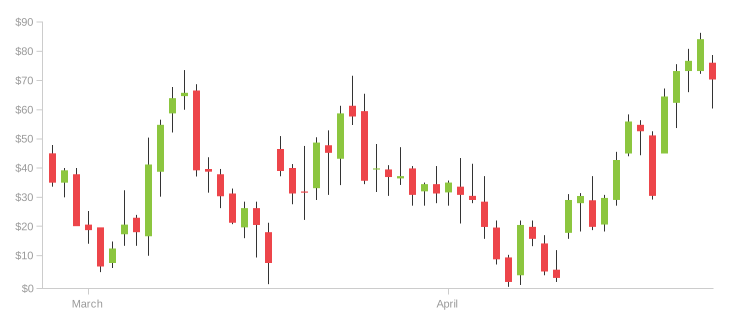
Candlestick charts are similar to bar charts but use colors to make bullish or bearish movements easier to see at a glance.
Example:
On a candlestick chart, a day where Company XYZ's stock price closed higher than it opened is typically shown as a white or green candle. A day where it closed lower is shown as a black or red candle.
Fact: Candlestick charts originated in Japan over 100 years ago and are now a staple among technical traders.
Real Story: A trader once spotted a bullish engulfing pattern on a candlestick chart. A small red candle was followed by a larger green candle. This signal led them to buy, and the stock price rose soon after.
Choosing the Right Stock Chart for Your Trading
By learning these types of stock charts, you can start to understand what the market is saying. Charts are a helpful tool, but they work best alongside other factors like news, market sentiment, and your own risk limits. Use them wisely to guide your decisions.
Short step-by-step plan:
Line Charts:
- Best for spotting overall price trends. A line chart connects closing prices over time to show if a stock is moving up, down, or sideways.
- Easy to read and great for beginners who want a quick look at a stock’s direction.
Bar Charts:
- Best for seeing daily price action. Each bar shows the open, high, low, and close (OHLC) for a period.
- Helps you understand a stock’s trading range and how much the price moved during the day.
Candlestick Charts:
- Best for spotting price patterns and reversals. Candlesticks show the same data as bar charts but use colors to make bullish and bearish moves easy to see.
- Widely used in technical analysis. The visual design makes patterns like engulfing and doji easy to recognize.
What Are the Different Types of Stock Charts?
The three main types of stock charts used by traders and investors are line charts, bar charts (also known as OHLC charts), and candlestick charts. Each type displays historical price data at different levels of detail. Line charts connect closing prices over time to show broad trends. Bar charts add the open, high, low, and close prices for each period. Candlestick charts present the same OHLC data as bar charts but use colored rectangular bodies to make bullish and bearish price action easier to interpret at a glance. The choice of chart type depends on the trader's strategy, experience level, and the specific analysis goals.
What is a line chart in stock trading?
A line chart is the simplest type of stock chart. It plots a single line that connects the closing prices of a security over a chosen time frame, such as days, weeks, or months. Line charts remove intraday noise and are best suited for identifying long-term trends and overall market direction.
What is a bar chart in stock trading?
A bar chart, also called an OHLC chart, displays four data points for each time period: the open price, the high price, the low price, and the closing price. Each vertical bar represents the price range for that period, with a horizontal tick on the left marking the open and a horizontal tick on the right marking the close. Bar charts help traders assess volatility and trading range.
What is a candlestick chart in stock trading?
A candlestick chart shows the same open, high, low, and close data as a bar chart but uses a visual design with a rectangular body and wicks. The body represents the range between the open and close prices. A filled or red body means the close was lower than the open (bearish), while a hollow or green body means the close was higher than the open (bullish). Candlestick charts are widely used in technical analysis because their visual patterns can signal potential market reversals or continuations.
Which type of stock chart is best for beginners?
Line charts are generally the best choice for beginners because they are the simplest to read and interpret. A line chart provides a clean view of a stock's price trend without the added complexity of opening, high, and low data. Once a beginner understands trend direction, they can move on to bar charts and candlestick charts for more detailed analysis.
What is the difference between a bar chart and a candlestick chart?
Bar charts and candlestick charts display the same open, high, low, and close price data. The main difference is visual presentation. Bar charts use vertical lines with horizontal ticks, while candlestick charts use filled or hollow rectangular bodies between the open and close prices. Candlestick charts make it easier to quickly see whether a period was bullish or bearish and to recognize specific patterns such as doji, engulfing, and hammer formations.
- What are the three main types of stock charts?
- The three main types of stock charts are line charts, bar charts (OHLC charts), and candlestick charts. Each type shows price data with increasing levels of detail and is suited to different trading styles and experience levels.
- What does a line chart show?
- A line chart shows only the closing prices of a stock over a set period, connected by a continuous line. It is the simplest chart and is best for identifying broad upward, downward, or sideways trends.
- What does a bar chart show?
- A bar chart shows the open, high, low, and closing prices for each time period. Each vertical bar represents the full trading range, with ticks on the left and right indicating the open and close prices respectively.
- What does a candlestick chart show?
- A candlestick chart shows the open, high, low, and close prices using colored rectangular bodies and wicks. The body color indicates whether the price closed higher (bullish) or lower (bearish) than it opened.
- Which stock chart type is best for technical analysis?
- Candlestick charts are the most popular choice for technical analysis because their visual design makes patterns such as doji, engulfing, and hammer formations easy to recognize. These patterns can signal potential price reversals or continuations.
- What is the difference between a bar chart and a candlestick chart?
- Bar charts and candlestick charts contain the same OHLC data. The difference is visual: bar charts use vertical lines with ticks, while candlestick charts use filled or hollow bodies between the open and close for faster interpretation of market sentiment.