

What Is Option Pricing?
Option pricing is the process used to estimate the fair or theoretical value of a call or put option. The market premium of an option continuously changes because several factors interact with each other. A change in the underlying price may increase an option’s value, while time decay may reduce it. Similarly, an increase in implied volatility can increase option premiums even when the underlying price remains relatively stable. This is why option prices cannot be understood by looking at the underlying price alone.
The major factors affecting option pricing include:
- Underlying asset price
- Strike price
- Time remaining until expiry
- Implied volatility
- Interest rates
- Expected dividends
Intrinsic Value vs Time Value in Options
An option premium consists primarily of intrinsic value and time value. Understanding these two components makes it easier to understand why different options on the same underlying asset can trade at very different premiums.
Intrinsic Value
Intrinsic value is the amount by which an option is currently in-the-money.
For a call option: Call Intrinsic Value = Max(Spot Price – Strike Price, 0)
For a put option: Put Intrinsic Value = Max(Strike Price – Spot Price, 0)
Call Option Example : Suppose a stock is trading at ₹1,050 and a call option has a strike price of ₹1,000.
Intrinsic Value = ₹1,050 – ₹1,000 = ₹50
If the option is trading at ₹68, the remaining ₹18 represents time value.
Put Option Example : Suppose a stock is trading at ₹950 and a put option has a strike price of ₹1,000.
Intrinsic Value = ₹1,000 – ₹950 = ₹50
If the put option premium is ₹65: Time Value = ₹65 – ₹50 = ₹15
Time Value
Time value represents the portion of an option premium above its intrinsic value.
Time Value = Option Premium – Intrinsic Value
An option with more time remaining until expiry generally has greater opportunity for the underlying asset to move in a favourable direction. This potential is reflected in its time value. As expiry approaches, time value generally decreases, although changes in the underlying price and implied volatility can offset some of this decline.
Factors Affecting Option Pricing
Several variables determine the theoretical and market value of an option. These factors interact continuously, which is why option premiums can change rapidly during volatile market conditions.
Underlying Price and Its Effect on Option Pricing
The price of the underlying asset is one of the most important factors affecting an option premium. For a call option, an increase in the underlying price generally increases the option’s value, while a decline generally reduces its value. For a put option, the relationship is generally reversed. A decline in the underlying price tends to increase the put option’s value, while an increase tends to reduce it.
For example, suppose an index is trading at 25,000 and a trader is observing the 25,000 call option. If the index moves higher, the call premium may increase, assuming other pricing factors remain unchanged. The exact change in the option premium depends on factors such as Delta, Gamma, implied volatility and time remaining until expiry.
Strike Price and Option Moneyness
The strike price is the predetermined price at which the underlying asset can be bought or sold under the terms of the option contract. The relationship between the strike price and current underlying price determines whether an option is in-the-money, at-the-money or out-of-the-money.
| Option Status | Call Option | Put Option |
|---|---|---|
| In-the-Money (ITM) | Spot price above strike | Spot price below strike |
| At-the-Money (ATM) | Spot price near strike | Spot price near strike |
| Out-of-the-Money (OTM) | Spot price below strike | Spot price above strike |
ITM options contain intrinsic value, while OTM options have no intrinsic value and consist primarily of time value before expiry. ATM options often contain substantial time value because relatively small movements in the underlying can move them into or out of the money.
Time to Expiry and Time Decay (Theta)
Time remaining until expiry plays an important role in option pricing. An option with more time until expiry generally has more opportunity for the underlying asset to move favourably. As a result, longer-dated options generally contain more time value than otherwise similar options approaching expiry.
As expiry gets closer, time value tends to decline. This process is known as time decay. Theta is the option Greek commonly used to measure the effect of the passage of time on an option’s theoretical value.
For buyers of options, Theta is generally negative because the passage of time reduces the option’s time value, assuming other factors remain unchanged. Time decay is not necessarily constant. It generally becomes more significant as expiry approaches, particularly for options around the at-the-money strike.
Implied Volatility (IV) and Option Premiums
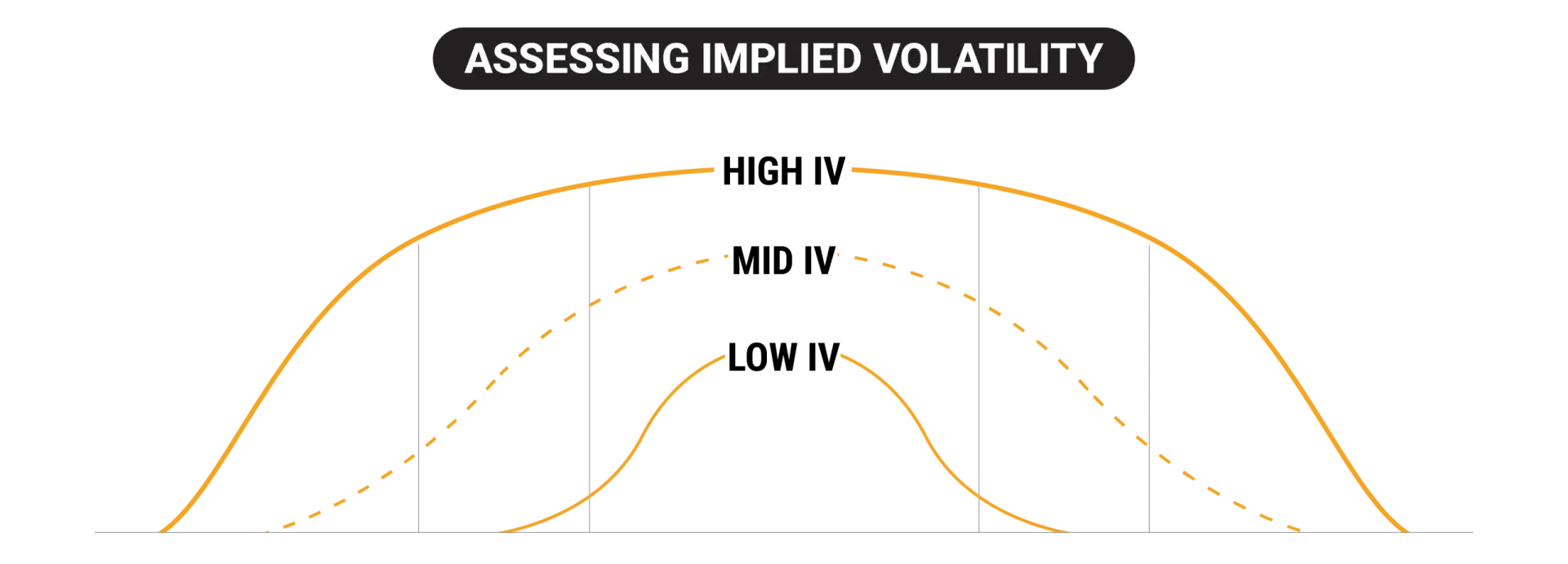
Implied volatility in options represents the market’s expectation of how much the underlying asset may move during the remaining life of the option. Higher implied volatility generally increases both call and put option premiums because greater expected price movement increases the probability of the option becoming more valuable before expiry. Lower implied volatility generally reduces option premiums when other factors remain unchanged.
For example, implied volatility may increase before major events such as:
- RBI monetary policy announcements
- Company earnings results
- Union Budget announcements
- Major economic data releases
- Important global central bank decisions
- Significant market or geopolitical events
Option premiums can therefore rise before an event even when the underlying asset has not moved significantly. After the event, implied volatility can fall sharply if uncertainty decreases. This decline can reduce option premiums and is commonly referred to by traders as an IV crush.
Interest Rates and Option Pricing
Interest rates are another input used in option pricing models. In theoretical option pricing, higher interest rates generally have a positive effect on call option values and a negative effect on put option values, assuming other variables remain unchanged.
The effect of interest rates is represented by the option Greek Rho. For short-duration options, the effect of interest rates may be relatively small compared with factors such as underlying price movement, implied volatility and time decay.
Dividends and Their Effect on Option Prices
Expected dividends can influence the theoretical value of stock options because a stock price may adjust when it trades ex-dividend. All else being equal, expected dividends generally reduce the theoretical value of call options and increase the theoretical value of put options.
Dividend expectations are therefore relevant when pricing options on dividend-paying stocks, particularly when the expected dividend occurs before the option expires.
How Option Greeks Affect Option Prices
Option Greeks measure how sensitive an option’s price is to changes in different variables. They can help explain why an option premium moves differently from the underlying asset.
| Greek | Measures | What It Indicates |
|---|---|---|
| Delta | Underlying price movement | Estimated change in option value for a change in the underlying price |
| Gamma | Change in Delta | How quickly Delta may change as the underlying moves |
| Theta | Passage of time | Effect of time decay on option value |
| Vega | Implied volatility | Sensitivity of the option premium to changes in IV |
| Rho | Interest rates | Sensitivity of option value to changes in interest rates |
Delta : Delta measures how sensitive an option premium is to changes in the underlying price. Call options generally have positive Delta, while put options generally have negative Delta.
Gamma : Gamma measures the rate at which Delta changes when the underlying asset moves. Gamma can become particularly important close to expiry, especially for options near the at-the-money strike.
Theta : Theta measures the effect of time decay. For a long option position, Theta generally represents the theoretical amount of value that may be lost as time passes, assuming other variables remain unchanged.
Vega : Vega measures an option’s sensitivity to changes in implied volatility. Higher implied volatility generally increases option premiums, while lower implied volatility generally reduces them.
Rho : Rho measures the sensitivity of an option’s theoretical value to changes in interest rates. Its effect is generally more noticeable in longer-dated options than in options close to expiry.
How to Calculate Option Price Using the Black-Scholes Model
The Black-Scholes model is one of the best-known mathematical models used to estimate the theoretical value of European-style options.
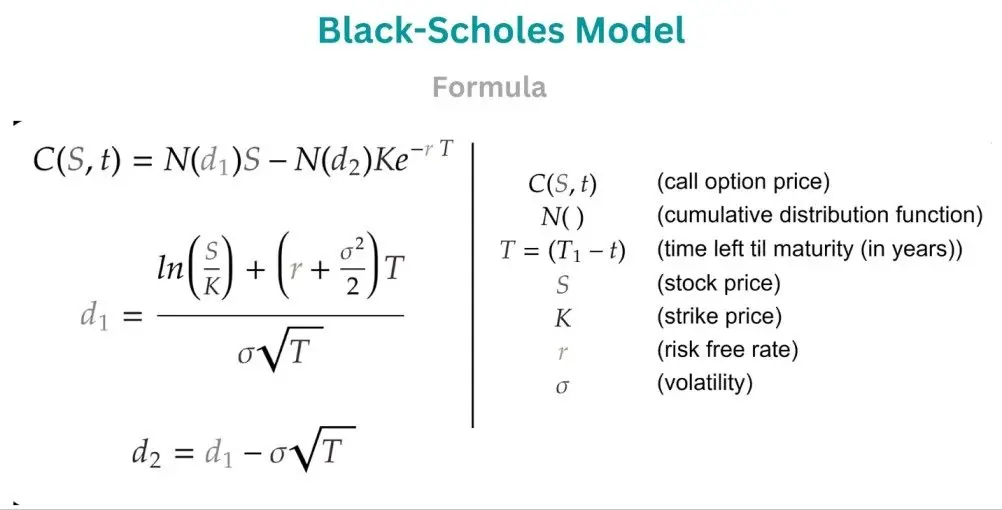
For a basic European call option without dividends, the Black-Scholes option pricing formula is: C = S × N(d1) – K × e^(-rT) × N(d2)
Where:
- C = Theoretical call option value
- S = Current price of the underlying asset
- K = Strike price
- T = Time remaining until expiry
- r = Risk-free interest rate
- σ = Volatility of the underlying asset
- N(d1) and N(d2) = Values obtained from the cumulative standard normal distribution
The values of d1 and d2 are calculated as: d1 = [ln(S/K) + (r + σ²/2)T] / (σ√T) , d2 = d1 – σ√T
The standard formula above assumes no dividend yield. Pricing models can be adjusted to account for dividends where applicable.
Black-Scholes Option Pricing Example
Consider a hypothetical call option with the following inputs:
| Input | Example Value |
|---|---|
| Underlying Price | ₹1,000 |
| Strike Price | ₹1,000 |
| Time to Expiry | 30 days |
| Volatility | 20% |
| Risk-Free Rate | 6% |
These inputs can be entered into the Black-Scholes formula or an option pricing calculator to estimate the theoretical value of the call option. Changing any input can change the calculated option value.
For example:
- Increasing the underlying price generally increases the call value.
- Increasing volatility generally increases the option value.
- Reducing the time remaining generally reduces time value.
- Changing the strike price changes the option’s moneyness and intrinsic value characteristics.
The Black-Scholes result should be viewed as a theoretical value, not a guaranteed market price.
Why Market Option Prices Can Differ From Theoretical Value
An option pricing model estimates theoretical value based on specific assumptions and inputs. The actual premium available in the market can differ from that theoretical value.
Market option prices can be influenced by:
- Changes in demand and supply
- Bid-ask spreads
- Liquidity
- Rapid changes in implied volatility
- Sudden underlying price movements
- Market expectations
- Event-related uncertainty
- Differences between model assumptions and actual market conditions
For this reason, a theoretical option value should not automatically be treated as the price at which an option can actually be bought or sold.
How the Main Option Pricing Factors Work Together
Option pricing factors do not operate independently. Consider a trader holding a call option.
The underlying asset may move higher, which can increase the option premium. At the same time, the option may be approaching expiry, causing time value to decline. If implied volatility also falls, the decline in Vega-related value may offset part of the benefit from the underlying price increase. This interaction explains why a trader can sometimes correctly anticipate the direction of the underlying asset but still see a smaller-than-expected increase in the option premium.
Understanding option pricing, implied volatility, time decay and option Greeks together provides a clearer picture of how option premiums behave.
Key Takeaways
- Option pricing is influenced by multiple variables rather than the underlying price alone.
- An option premium broadly consists of intrinsic value and time value.
- The main factors affecting option pricing include the underlying price, strike price, time to expiry, implied volatility, interest rates and dividends.
- Call and put options respond differently to changes in the underlying price.
- Time value generally declines as an option approaches expiry.
- Higher implied volatility generally increases both call and put premiums.
- Delta, Gamma, Theta, Vega and Rho help measure different option pricing sensitivities.
- The Black-Scholes model can estimate theoretical option value, but actual market premiums can differ from calculated values.
- Option pricing factors interact with each other, so a premium may change even when the underlying asset moves very little.
Frequently Asked Questions About Option Pricing
What is option pricing?
Option pricing is the process of determining the theoretical or market value of an options contract. The price paid for an option is known as the option premium and is influenced by the underlying price, strike price, time to expiry, implied volatility, interest rates and expected dividends.
How is an option premium calculated?
An option premium can broadly be divided into intrinsic value and time value.
Option Premium = Intrinsic Value + Time Value
Pricing models such as Black-Scholes can also be used to estimate the theoretical value of an option using variables including the underlying price, strike price, volatility, interest rate and time remaining until expiry.
What are the main factors affecting option pricing?
The main factors affecting option pricing are the underlying asset price, strike price, time remaining until expiry, implied volatility, interest rates and expected dividends. These variables interact with each other, so an option premium may change even when the underlying asset remains relatively stable.
What is intrinsic value in options?
Intrinsic value is the amount by which an option is currently in-the-money.
For a call option: Intrinsic Value = Max(Spot Price – Strike Price, 0)
For a put option: Intrinsic Value = Max(Strike Price – Spot Price, 0)
An out-of-the-money option has zero intrinsic value.
What is time value in options?
Time value is the portion of an option premium above its intrinsic value.
Time Value = Option Premium – Intrinsic Value
Time value reflects the possibility that the option may become more valuable before expiry.
Why does an option premium decrease near expiry?
As an option approaches expiry, there is less time available for the underlying asset to make a favourable move. As a result, the time value component of the option generally decreases. This effect is known as time decay and is measured by Theta.
How does implied volatility affect option prices?
Higher implied volatility generally increases option premiums because the market is expecting a wider range of possible price movements. A decline in implied volatility generally reduces option premiums when other factors remain unchanged.
What is the Black-Scholes model?
The Black-Scholes model is a mathematical option pricing model used to estimate the theoretical value of European-style options based on variables such as the underlying price, strike price, time to expiry, volatility and risk-free interest rate.
Can the Black-Scholes model predict the exact market price of an option?
No. The Black-Scholes model provides a theoretical value based on its inputs and assumptions. Actual option premiums can differ because of liquidity, bid-ask spreads, demand and supply, rapidly changing volatility, market expectations and other real-world factors.
Why can option premiums rise when the underlying price does not move much?
Option premiums are affected by more than the underlying price. A significant increase in implied volatility can increase the time value of an option even when the underlying asset has moved very little. This is one reason traders monitor implied volatility along with the direction of the underlying asset.