
What is the Concept Of Risk Management in Options Trading.
Why Options Expire Worthless (And How Risk Management Helps)

Options trading can offer big rewards, but it also comes with risks. Unlike stocks, options have an expiration date. If the market does not move in your favor before that date, the option can become worthless. That is why understanding risk management in options trading is so important. It helps you protect your money and trade with more confidence.
What Is Risk Management in Options Trading?
Risk management in options trading is the process of spotting risks, understanding them, and taking steps to reduce them. The goal is simple: make smart choices that protect your money.
🔑 Key Terms in Risk Management
- 📉 Volatility: How fast an option’s price moves up or down.
- 📅 Expiration Date: The date when the option contract ends and becomes void.
- 🛡️ Hedging: A strategy used to offset possible losses in your investments.
- 💰 Position Sizing: How much money you put into one trade compared to your total capital.
- 📈 Diversification: Spreading your investments across different assets to lower risk.
What Are the Greeks in Options Trading?
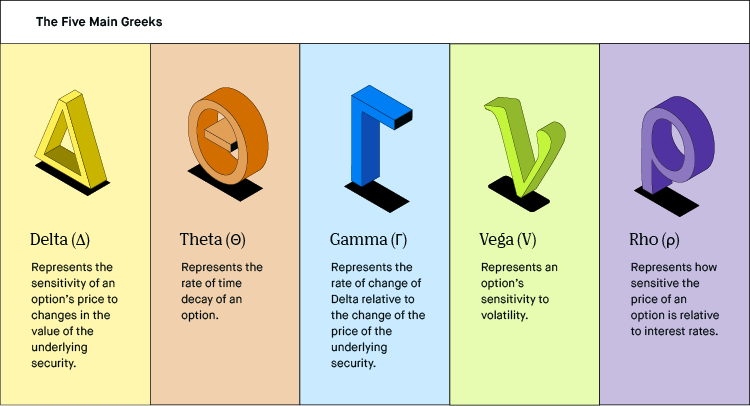
The ‘Greeks’ are important tools for managing risk in options trading. They measure how different factors affect an option’s price.
🔢 Delta

Delta shows how much an option’s price changes when the stock price moves by $1. For example:
If an option has a delta of 0.5, a $1 increase in the stock price might increase the option's price by $0.50.\n🔄 Gamma
Gamma measures how fast delta changes when the stock price moves by $1. It shows how quickly the option’s price can speed up or slow down.
⏳ Theta
Theta measures time decay. It tells you how much an option’s price drops each day as it gets closer to its expiration date.
💧 Vega
Vega shows how much an option’s price changes when market volatility goes up or down.
💵 Rho
Rho measures how much an option’s price changes when interest rates change.
How to Use Risk Management Strategies
🛡️ Hedging Strategies
Hedging is like buying insurance for your trades. You can use strategies like protective puts or covered calls to protect yourself.
💰 Money Management
Good money management is key. Only risk a small part of your total capital on one trade. This helps you avoid big losses.
📊 Portfolio Diversification
Do not put all your money in one place. Spread your investments across different assets and markets to lower your overall risk.
📉 Stop-Loss Orders
A stop-loss order sells your option automatically when it reaches a certain price. This helps limit how much you can lose.
📚 Continuous Education
Keep learning about the markets. Stay up to date on new strategies and ways to manage risk.
Real Examples of Risk Management
In 2008, many traders lost money when the markets crashed. But those who used good risk management strategies, like diversification and hedging, handled their losses better and recovered over time.
Risk management in options trading is not just a safety net. It is a key part of every trader’s plan. By learning about volatility, the Greeks, and ways to reduce risk, you can protect your money and trade with more confidence. Remember, the goal is not to remove all risk. It is to manage risk wisely.
Short step-by-step plan:
Start by learning about the different risks in options trading, such as market risk, volatility risk, and liquidity risk. For example, market risk is the chance of losing money when the price of the underlying asset moves the wrong way. Look at real examples of how market risk has affected options traders in the past.
Study the different ways to manage risk in options trading, such as hedging, diversification, and position sizing. Learn how traders use hedging to protect their portfolios from bad market moves.
Understand how probability and statistics help with risk management in options trading. Look at real stories where probability and statistics helped traders manage risk well.
Learn why having a clear risk management plan is so important for options trading. Look at facts and figures that show the difference between traders who have a plan and those who do not.
Risk Management in Options Trading: A Complete Guide to Protecting Your Capital
Risk management in options trading is the practice of identifying, assessing, and controlling potential financial losses when trading option contracts. It involves using tools such as position sizing, stop-loss orders, hedging strategies, and the option Greeks to limit downside exposure while preserving the ability to profit from market movements. The primary goal is not to eliminate risk entirely but to ensure that no single trade can significantly damage your trading account.
What Does Risk Management Mean in Options Trading?
Risk management in options trading refers to the systematic process of identifying potential losses, measuring their likelihood and impact, and taking deliberate steps to reduce or control them. It includes setting rules for how much capital to risk per trade, using hedging techniques to offset adverse movements, and continuously monitoring positions to adjust as market conditions change.
What Are the Most Common Risks in Options Trading?
The main risks in options trading include market risk (the price of the underlying asset moves against your position), time decay risk (theta erodes the option's value as expiration approaches), volatility risk (changes in implied volatility affect option prices), and liquidity risk (difficulty entering or exiting a position at a fair price). Traders must also account for assignment risk when selling options.
How Do the Greeks Help With Risk Management?
The Greeks are mathematical measures that help traders understand how different factors affect an option's price. Delta measures price sensitivity to the underlying asset's movement, gamma tracks how delta changes, theta measures time decay, vega measures sensitivity to volatility, and rho measures sensitivity to interest rates. By monitoring the Greeks, traders can anticipate how their positions will behave under various market scenarios.
What Are Simple Risk Management Strategies for Beginners?
Beginners can start with position sizing (risking only 1-2% of capital per trade), using stop-loss orders to cap losses, trading smaller contract sizes, and avoiding high-risk strategies like naked options. Learning to read the Greeks and practicing with a paper trading account before committing real money are also essential first steps.
Why Is Position Sizing Important for Option Traders?
Position sizing determines how much capital you allocate to a single trade. It is one of the most effective risk management tools because it ensures that a series of losing trades does not deplete your account. A common rule is to risk no more than 1-2% of your total trading capital on any single options position.
- What is the most important rule of risk management in options trading?
- Never risk more than you can afford to lose on a single trade, and always use a stop-loss or predefined exit plan to limit losses before entering any position.
- How much capital should I risk on a single options trade?
- Most experienced traders risk no more than 1% to 2% of their total trading capital on any single options trade to ensure that a losing streak does not wipe out their account.
- Can you lose more money than you invest in options trading?
- Yes, depending on the strategy. Buying options limits your loss to the premium paid, but selling naked options can result in losses that exceed your initial investment, which is why risk management is critical.
- What is the difference between hedging and diversification?
- Hedging involves taking an offsetting position to protect against losses in a specific trade, while diversification spreads capital across different assets to reduce overall portfolio risk without directly offsetting any single position.
- How do stop-loss orders work for options?
- A stop-loss order automatically closes your options position when the price reaches a predetermined level, helping you exit a losing trade before losses grow larger than planned.
- What is the 1% rule in options trading risk management?
- The 1% rule means you never risk more than 1% of your total trading capital on a single trade, so if your account has ₹1,00,000, your maximum loss per trade is limited to ₹1,000.
