
Implement Risk-Reward Ratios To Optimize Trading Strategies

How to Use Risk-Reward Ratios to Trade Smarter

📈 Risk-Reward Ratios

Risk-Reward Ratios

Learning risk-reward ratio basics helps you see the potential profit for every dollar you risk. A common ratio is 1:3, meaning you aim to make three times what you risk.

🔑 The Key Components of a Risk-Reward Ratio

Key Components of a Risk-Reward Ratio

  • Risk: The amount you could lose on a trade.

  • Reward: The potential profit you aim to make.

🧮 Calculating the Risk-Reward Ratio

Calculating the Risk-Reward Ratio

Risk-Reward Ratio = Potential Reward / Potential Risk

For example, if you stand to lose $100 on a trade but could gain $300, your risk-reward ratio is 1:3.

🚦 Setting Up Your Trade with Risk-Reward in Mind

Setting Up Your Trade with Risk-Reward in Mind

  • Step 1: Determine your stop-loss (the point where you’ll exit a losing trade).

  • Step 2: Identify your take-profit level (where you’ll exit with profit).

  • Step 3: Calculate the risk-reward ratio before entering the trade.

💡 Example of Implementing Risk-Reward Ratios

Imagine you buy a stock at $50, place a stop-loss at $45, and aim for a take-profit at $65.

  • Risk: $5 per share (from $50 to stop-loss at $45)

  • Reward: $15 per share (from $50 to take-profit at $65)

  • Risk-Reward Ratio: 1:3

📊 Adjusting Position Size Based on Risk-Reward
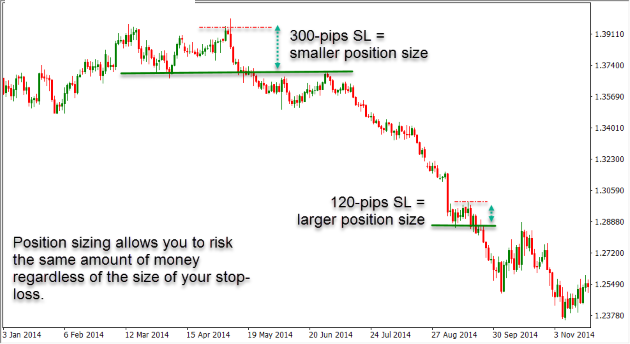
Adjusting Position Size Based on Risk-Reward

Applying position sizing techniques ensures you’re never risking more than a set percentage of your portfolio on a single trade, typically 1-2%.

📚 How Top Traders Manage Risk

Traders like Paul Tudor Jones credit their success to strict risk management. They focus not just on how much they make, but on how much they don’t lose.

🔄 The Role of Risk-Reward in Various Trading Strategies
The Role of Risk-Reward in Various Trading Strategies

  • Day Trading: Quick, small gains with tight risk-reward ratios.

  • Swing Trading: Larger gains over several days or weeks, with more generous risk-reward ratios.

🛠️ Tools for Managing Risk-Reward

Many trading platforms offer tools to set stop-loss and take-profit levels, automatically calculating the risk-reward ratio for you.

🎓 Practice to Master Risk-Reward Ratios

Practice Makes Perfect

The best way to master risk-reward ratios is to practice and review your past trades. Using these principles every day helps you build discipline and improve your results over time.

How to put risk-reward ratios to work:

  1. Learn to calculate the ratio. If a trade could earn $500 and you risk $100, your ratio is 5:1. You stand to gain five times what you could lose.

  2. Set a minimum ratio for your trades. Only take trades with a ratio of 2:1 or higher. This keeps your potential profit ahead of your risk.

  3. Review your past trades. Look at how different ratios affected your results. Trades with higher ratios may lead to better overall returns.

  4. Use ratios to guide your stop-loss and position size. Before you enter a trade, set your stop-loss based on the ratio. Adjust your trade size so you never risk too much on one trade.

  5. Create your own trading rules. For example, require a minimum 3:1 ratio on all trades. Follow your rules to stay disciplined and consistent.

best bank nifty option tips provider in india

Free Registration for Stock Market Tips ( Advisory Services)

As per the SEBI rules, we will provide our Services only to those clients who have Complete Risk Profile. Fill This Registration Form  and 
Contact us on

  • Whatsapp @ +91 95999 69624
  • Call Us @ +91 9650 890 321 
    for  further process.

Risk Profiling is COMPULSORY

Risk-Reward Ratios Explained: What They Are and How to Use Them

A risk-reward ratio compares the potential profit of a trade to its potential loss. It is calculated by dividing the amount a trader stands to gain by the amount they stand to lose. For example, a risk-reward ratio of 1:3 means a trader risks one unit of currency to gain three units. Traders use this ratio to evaluate whether a trade offers enough potential return relative to its risk before entering a position.

What is a risk-reward ratio in trading?

A risk-reward ratio is a measure that compares the expected profit of a trade to the amount at risk. It is expressed as two numbers separated by a colon, such as 1:2 or 1:3. The first number represents the risk, and the second represents the potential reward. This ratio helps traders determine whether a trade is worth taking based on how much they could gain for each unit of currency they risk.

How do you calculate a risk-reward ratio?

To calculate the risk-reward ratio, divide the potential reward by the potential risk. The potential risk is the difference between the entry price and the stop-loss price. The potential reward is the difference between the entry price and the take-profit price. For example, if a trader enters at $50, sets a stop-loss at $45 (risk of $5), and a take-profit at $65 (reward of $15), the risk-reward ratio is 1:3.

What is considered a good risk-reward ratio?

Many traders consider a risk-reward ratio of at least 1:2 or 1:3 as favorable. A ratio of 1:2 means the potential reward is twice the risk, and 1:3 means it is three times the risk. The ideal ratio depends on the trader's strategy, win rate, and market conditions. A higher ratio provides a greater margin for error and can compensate for a lower percentage of winning trades.

How does the risk-reward ratio affect position sizing?

Traders use the risk-reward ratio alongside their account size to determine appropriate position sizes. By first setting a maximum acceptable loss per trade, typically 1 to 2 percent of the account, the trader can then calculate how many units to trade based on the distance between the entry price and stop-loss level. The risk-reward ratio ensures that the potential loss stays within the predetermined limit.

Can a trading strategy be profitable with a low win rate?

Yes. A strategy with a win rate below 50 percent can still be profitable if it uses favorable risk-reward ratios. For example, a strategy with a 40 percent win rate and a 1:3 risk-reward ratio produces a positive expected value because the average winning trade is three times larger than the average losing trade. The ratio compensates for the lower frequency of wins.

How do stop-loss and take-profit levels relate to the risk-reward ratio?

The stop-loss defines the risk amount, and the take-profit defines the reward amount. The distance from the entry price to the stop-loss represents the risk per unit, while the distance from the entry price to the take-profit represents the reward per unit. The risk-reward ratio is the comparison of these two distances. Setting both levels before entering a trade ensures the ratio is known in advance.

What is a risk-reward ratio in trading?
A risk-reward ratio compares the potential profit of a trade to its potential loss, expressed as two numbers such as 1:3, meaning the trader risks one unit to potentially gain three units.
How do you calculate a risk-reward ratio?
Divide the potential reward (distance from entry to take-profit) by the potential risk (distance from entry to stop-loss). A trade risking $5 to gain $15 has a 1:3 ratio.
What is considered a good risk-reward ratio?
Many traders aim for at least 1:2 or 1:3. The right ratio depends on the strategy's win rate and the trader's risk tolerance.
How does the risk-reward ratio affect position sizing?
Traders set a maximum loss per trade, typically 1-2% of their account, then use the ratio to determine how many units to trade while keeping risk within that limit.
Can a trading strategy be profitable with a low win rate?
Yes. A 40% win rate can be profitable if winning trades are three times larger than losing trades, as a high risk-reward ratio offsets a lower win rate.
How do stop-loss and take-profit levels relate to the risk-reward ratio?
The stop-loss sets the risk distance and the take-profit sets the reward distance. The ratio of these two distances defines the risk-reward ratio.
Scroll to Top